

Looking for the Best IVF Doctor in Noida? Here’s What Actually Matters
The best IVF doctor in Noida isn’t just someone with a decorative clinic — it’s someone who runs proper diagnostics test before recommending any treatment, explains your options honestly and in detail, and has genuinely handled thousands of cases like yours. Experience, transparency, and an in-house lab all matter more than marketing.
What Does a Fertility Specialist in Noida Actually Do Before Suggesting IVF?
A good specialist never jumps directly to IVF. They start with the proper diagnostic workup — hormone tests, scans, and semen analysis — to actually figure out why conception isn’t happening, then recommend the least invasive effective option first rather than going to hard treatments first.
Here’s the thing nobody tells you upfront: IVF is often not the first step. It’s the third or fourth. A genuine fertility specialist in Noida will usually start with:
- AMH (Anti-Müllerian Hormone) testing — to estimate ovarian reserve, not “how many eggs are left” and have a real picture of ovarian response.
- HSG (Hysterosalpingogram) — an X-ray-based test to check if the fallopian tubes are open or it is blocked.
- Semen analysis for the male partner — because, plainly, infertility isn’t automatically a “female problem.” Roughly 40-50% of infertility cases involve a male factor, either alone or combined.
- Pelvic ultrasound — to look for fibroids, cysts, or structural issues like PCOS.
- Basic thyroid and prolactin panels — because hormonal imbalances quietly sabotage a lot of cycles.
At Dr. Parul Agrawal Fertility in Sector 92, this overall diagnostic process — consultation, blood work, imaging, and even surgical evaluation if needed — happens under one roof. That matters more than it sounds like it should. Running between three different labs and two different clinics adds weeks to an ongoing process that’s already emotionally exhausting for partners.
Dr. Parul Agrawal brings 23+ years of clinical experience to this stage, and that experience shows up less in confidence and more in pattern recognition — knowing which subtle test result actually explains the bigger picture.
IUI vs IVF: Which One Do You Actually Need?
IUI is a simpler, less invasive procedure best suited for mild infertility factors, while IVF is recommended for more complex issues like blocked tubes, low sperm count, or after IUI hasn’t worked. A good doctor should walk you through both before deciding.
This is probably the single most confusing part for new patients. So let’s lay it out plainly.
| Factor | IUI (Intrauterine Insemination) | IVF (In Vitro Fertilization) |
| What happens | Washed sperm placed directly into the uterus during ovulation | Eggs retrieved, fertilized with sperm in a lab, embryo transferred back |
| Best suited for | Mild male factor, unexplained infertility, ovulation issues | Blocked tubes, severe male factor, failed IUIs, modern maternal age |
| Typical cycle length | Roughly 2 weeks per cycle | Around 4-6 weeks including stimulation, retrieval, and transfer |
| Invasiveness | Low, no sedation typically needed | Moderate, involves egg retrieval under sedation |
| Cost (relative) | Lower per cycle | Higher per cycle |
| Number of cycles usually tried | 3-4 cycles before reassessment | Often considered after IUI fails, or directly for specific diagnoses |
Notice nothing here says one option is “better.” They solve different problems. A good doctor will match the treatment to your actual diagnosis, not just a default treatment to whichever procedure is more profitable to them.
How Many IUI Cycles Before IVF Actually Makes Sense?
Most fertility specialists recommend trying 3-4 IUI cycles before moving to IVF, though this depends heavily on age, diagnosis, and how the ovaries respond to stimulation each cycle.
Plus, age plays a huge role here than most people expect. If you’re under 35 with mild issues, 3-4 IUI attempts is a reasonable, medically sound approach. But honestly, if you’re closer to 38-40, or if there’s a clear structural or a particular male-factor issue, waiting through multiple failed IUI cycles can just eat away at your most fertile window unnecessarily.
This is exactly why an experienced fertility specialist in Noida — someone who has actually supervised thousands of both IUI and IVF cycles — matters. Dr. Parul Agrawal Fertility has completed thousands of IUI treatments and IVF cycles, which means the decision of “try one more IUI” versus “move to IVF now” is based on pattern-level clinical judgement, not guesswork.
What Causes Infertility — And Where Do Most Couples Get It Wrong?
Infertility is rarely caused by just one factor, and it’s almost never “just the woman’s fault.” Common causes include ovulation disorders, tubal blockages, male factor issues, and unexplained infertility — and the biggest misconception is that trying naturally longer will eventually fix it.
Let’s clear up a few things that cause real emotional damage when left unaddressed.
Misconception 1: “If we just relax, it’ll happen.”
Stress management helps overall wellbeing, sure, but it doesn’t unblock a fallopian tube or fix low sperm motility. If there’s an underlying medical cause, time alone won’t resolve it.
Misconception 2: “It’s always about the woman’s age.”
Age matters, no doubt — IVF success rates do generally decline gradually after 35, and more noticeably after 38. But male fertility declines too, just more slowly, and sperm quality issues are involved in close to half of all infertility cases.
Misconception 3: “IVF always works immediately.”
It doesn’t, and if any clinic promising a guaranteed results to you it should raise a red flag immediately. IVF success depends on your egg quality, sperm quality, uterine receptivity, and embryo development — multiple variables, not one switch.
Misconception 4: “Male infertility isn’t really a medical condition.”
This one causes real harm. A proper male-factor evaluation should include semen analysis, hormonal evaluation, and sometimes minor surgical correction (like for varicocele) — not just a vague “take some vitamins” suggestion.
Male Infertility Treatment in Noida — Why It’s Often the Missing Piece
Here’s something that doesn’t get said enough: couples often spend months in investigating only the female partner while the male partner’s check up gets skipped overly, sometimes out of social discomfort. That delay costs you the time nobody trying to conceive has to spare.
A thorough male infertility treatment in Noida approach typically includes semen analysis (checking count, motility, and morphology), hormonal blood work, and — where needed — minor surgical procedures like varicocelectomy take place for male partner. Dr. Parul Agrawal Fertility’s in-house diagnostic and surgical setup means male-factor evaluation happens in parallel with the female partner’s check up, not as an afterthought weeks later.
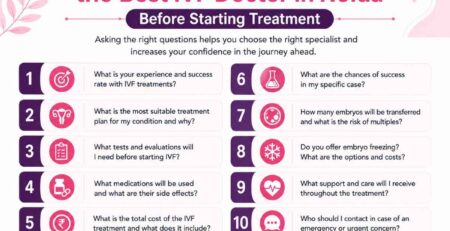
Checklist: What to Ask Before Choosing a Fertility Specialist in Noida
Before you commit to a clinic, here’s a practical checklist worth going through together as a couple:
- ,just push straight to a procedure? Does the doctor explain the diagnosis clearly to you or not
- will you be sent to multiple external centers? Is there an in-house IVF lab and diagnostic setup or they will send you across different labs.
- does the specialist actually have — not just the clinic’s age, but the doctor’s personal case volume? How many years of hands-on experience the Docter have
- semen analysis and hormonal panels? Does the clinic evaluate the male partner thoroughly or just check them upfront only.
- using general ranges rather than guaranteed numbers? Are success expectations discussed honestly, or they are only showing the numbers to you.
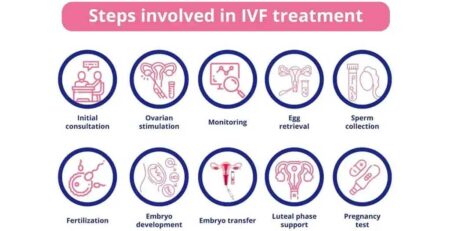
- stimulation phase (usually 10-14 days), egg retrieval, and the roughly two-week wait before a pregnancy test? What’s the real timeline of cycle.
- (laparoscopy/hysteroscopy) if structural issues like fibroids or endometriosis are found? Is there support for surgical intervention or not.
Dr. Parul Agrawal Fertility checks these boxes with 23+ years of experience, thousands of IVF cycles, IUI treatments, and laparoscopic and hysteroscopic surgeries performed — all coordinated from the Sector 92, Noida facility, so consultation, testing, surgery, and lab work don’t mean juggling with five different addresses.
Also, don’t underestimate how much communication style matters. A doctor who rushes through appointments or dismisses your questions isn’t the right fit for your treatment, no matter how impressive their case numbers looks on paper.
Frequently Asked Questions
Q1: What actually makes one clinic a better fit than another for a specific case?
The “best” fit depends on your specific diagnosis. Someone with huge experience over both simple and complex cases — like managing PCOS-related infertility, tubal blockages, and male factor issues — is generally better positioned to individualize treatment rather than following a one-size-fits-all protocol.
Q2: Is male infertility treatment in Noida covered under the same consultation as female fertility evaluation?
At clinics with an integrated setup, yes. It typically starts with a semen analysis alongside the female partner’s initial hormone and imaging tests, so both factors are assessed together rather than individually or sending them to different clinic again and again.
Q3: How soon after starting treatment can couples expect to know if IVF is working?
After embryo transfer, there’s generally a wait of about two weeks before a blood pregnancy test which can give you a real result. Testing too early with a home kit often leads to inaccurate readings and unnecessary anxiety.
Q4: Does age really determine whether someone should Search for help sooner rather than later?
Age is one of the huge factors, not the only one. That said, since IVF success rates generally decline gradually after 35, couples in this age range — or those who’ve been trying for over six months without success — are usually advised to consult a fertility specialist in Noida sooner rather than waiting out a full year of natural attempts.
Conclusion
Finding the best IVF doctor in Noida isn’t about finding a miracle worker. It’s about finding someone who diagnoses honestly, treats both partners equally, and has genuinely walked thousands of couples through this exact uncertainty before. That combination of experience, transparency, and an integrated Sector 92 facility is what Dr. Parul Agrawal Fertility has built its practice around — one diagnostic conversation at a time.








Leave a Reply