
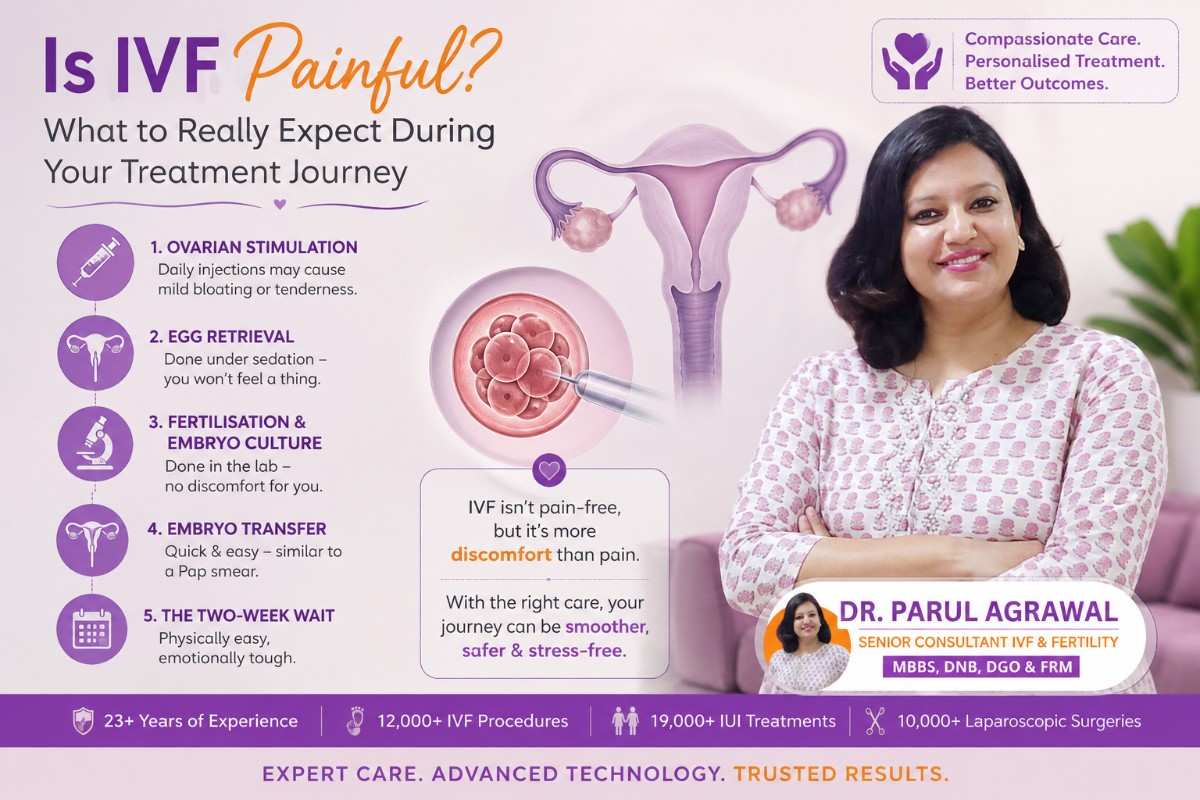
Is IVF Painful? What to Really Expect During Your Treatment Journey
IVF isn’t pain-free, but it’s not the ordeal most people imagine either. Most steps feel more like discomfort — bloating, mild cramping, a pinch from injections — than actual pain. Egg retrieval is done under sedation, so you won’t feel it happen. Honestly, the emotional rollercoaster is usually harder than the physical part.
Here’s the thing — almost every patient who walks in for a first consultation asks some version of the same question: “Will this hurt?” It’s a fair worry. Nobody wants to sign up for weeks of pain without knowing what’s actually coming. So let’s break it down honestly, stage by stage, so you know exactly what your body will go through — and why the right fertility specialist in Noida makes that journey feel far less overwhelming.
Is IVF Actually Painful, Or Just Uncomfortable?
For most patients, IVF causes discomfort rather than sharp pain — think bloating, tenderness, and injection-site soreness. Pain tolerance varies person to person, but very few patients describe IVF as unbearable. Any patient searching for the best infertility specialist in Noida should know that a skilled team makes a real difference in how manageable the process feels.
Plus, a lot of the anxiety around IVF comes from stories that circulate online — often the worst-case ones. In reality, most women describe the stimulation phase as annoying rather than painful. The daily hormone injections sting for a second, similar to a quick pinch. Some days you’ll feel bloated and heavy, almost like early period symptoms. Egg retrieval, the part everyone worries about most, is done under sedation at the clinic, so you’re asleep and feel nothing during the actual procedure.
That said, everyone’s experience is a little different. Also, working with the best infertility specialist in Noida matters here — an experienced team adjusts your protocol and medication doses so you’re not pushed through unnecessary discomfort. At Dr. Parul Agrawal Fertility in Sector 92, Noida, protocols are personalised rather than one-size-fits-all, which genuinely changes how the whole cycle feels.
What Happens During Each Stage of IVF — And Does It Hurt?
IVF has four main stages — ovarian stimulation, egg retrieval, fertilisation, and embryo transfer — and each carries a different, generally mild, level of discomfort. Nothing about the process is designed to hurt; sedation and pain management are built into the steps that could otherwise be uncomfortable.
1. Ovarian Stimulation (Days 1–14, roughly)
So this is where it starts. You’ll take daily hormone injections for about 10–14 days to encourage your ovaries to produce multiple eggs instead of just one. The needles are tiny — most patients say the pinch is over before they even register it. As your follicles grow, you might feel bloating, mild pelvic pressure, or tenderness, similar to PMS. Blood tests and ultrasounds (usually every 2–3 days) monitor your progress, and honestly, these appointments are more time-consuming than painful.
2. Egg Retrieval (Day 14–ish)
This is the step most people dread, but it’s also the most controlled. Retrieval is done under light sedation or anaesthesia in a clinical setting, so you’re comfortable and unaware during the actual procedure. Afterward, you might feel crampy or sore for a day or two — similar to period cramps — and mild bloating is common. Rest is usually recommended for that day.
3. Fertilisation and Embryo Culture (Days 3–5 post-retrieval)
Nothing happens to your body here — this part is entirely in the lab. Eggs and sperm are combined (or ICSI is used for male-factor cases), and embryos are monitored as they grow for 3 to 5 days before transfer.
4. Embryo Transfer
This is often described as the easiest step. No sedation is needed. It’s similar to a Pap smear — a thin catheter places the embryo into the uterus. Most patients say it’s over in minutes with barely any discomfort.
5. The Two-Week Wait
Physically, there’s little happening. Emotionally? This is usually the hardest part of the entire cycle — the waiting, the symptom-spotting, the uncertainty. Plus, hormone support medications (progesterone, in particular) can cause bloating or mood shifts.
IUI vs IVF: How Do They Compare on Discomfort and Process?
Since a lot of patients weigh IUI before considering IVF, here’s how the two stack up:
| Factor | IUI | IVF |
| Procedure discomfort | Minimal — similar to a Pap smear | Mild to moderate; retrieval under sedation |
| Medication | Oral or low-dose injectable hormones | Daily injectable hormones for 10–14 days |
| Monitoring visits | 2–4 visits per cycle | 6–8 visits per cycle |
| Recovery time | Same day | 1–2 days rest after retrieval |
| Typical cycles before switching | 3–4 IUI cycles typically tried first | Often recommended after repeated IUI failure or specific diagnoses |
| Success factors | Lower per-cycle success, less invasive | Higher per-cycle success, more controlled process |
So, IUI is gentler and simpler, but it isn’t right for every diagnosis. This is exactly where a conversation with a fertility specialist in Noida becomes useful — to understand which path actually fits your specific situation instead of guessing.
What Are the Biggest Misconceptions About IVF Pain?
Most fears about IVF pain come from outdated stories, movie portrayals, or a handful of extreme social media posts — not from what actually happens in a modern, well-run clinic. Here are the myths worth debunking.
Myth 1: “The injections are excruciating.”
Honestly, this is one of the most exaggerated fears. The needles used are extremely fine, and most patients self-administer them at home within a day or two of learning the technique. Discomfort is real but brief — nothing close to “excruciating.”
Myth 2: “Egg retrieval is done while you’re fully awake.”
Not true. Retrieval happens under sedation or light anaesthesia, so you don’t feel the procedure itself. Any soreness comes afterward, not during.
Myth 3: “IVF pain means something is going wrong.”
Also not accurate. Bloating, mild cramping, and tenderness are expected side effects of hormone stimulation — not signs of failure. That said, sudden severe pain should always be reported to your clinic immediately, since it could point to something like ovarian hyperstimulation syndrome (OHSS), which your care team monitors for closely.
Myth 4: “Every clinic and every cycle feels the same.”
This one matters a lot. Protocols, medication doses, and pain management approaches differ between clinics — which is exactly why choosing the best infertility specialist in Noida genuinely changes your physical experience, not just your success odds. Also, patients who research the best infertility specialist in Noida ahead of time tend to walk into their first injection appointment far less anxious, simply because they know what to expect.
What Should You Ask Before Choosing a Fertility Specialist?
Before committing to a clinic, ask about the doctor’s experience, lab quality, protocol customisation, and how they manage pain and side effects. A transparent team will walk you through all of this before you even start.
Use this checklist during your first consultation:
- Ask about experience. How many IVF cycles has the doctor personally overseen? Dr. Parul Agrawal has led over 12,000 IVF cycles and 19,000 IUI treatments across more than 23 years of practice.
- Ask about the lab. Is the embryology lab on-site, or are samples sent elsewhere? An in-house lab, like the one at Dr. Parul Agrawal Fertility in Sector 92, Noida, reduces delays and handling risks.
- Ask about surgical backup. Does the clinic offer laparoscopic or hysteroscopic correction if needed? This matters for patients with fibroids, endometriosis, or blocked tubes.
- Ask how pain and side effects are managed. A good fertility specialist in Noida should explain sedation protocols, medication adjustments, and what “normal” discomfort looks like versus a red flag. Honestly, this single question tends to separate an average clinic from the best infertility specialist in Noida you could be working with.
- Ask about personalisation. Are protocols standard, or adjusted to your hormone levels, age, and diagnosis?
- Ask about support between appointments. Can you reach the clinical team if you’re unsure whether a symptom is normal?
Choosing the best infertility specialist in Noida isn’t just about success rates on a website — it’s about how supported and informed you feel at every single step, especially the physically uncomfortable ones.
Frequently Asked Questions
Q1: Does the IVF injection process hurt a lot?
Not really. The needles are very fine, and most patients describe the sensation as a quick pinch rather than real pain. Bruising or mild soreness at the injection site is more common than actual pain.
Q2: Is egg retrieval painful?
No — it’s performed under sedation or light anaesthesia, so you won’t feel the procedure itself. Afterward, mild cramping or bloating for a day or two is normal.
Q3: How painful is the embryo transfer?
Barely at all. No sedation is needed, and most patients compare it to a routine gynaecological exam. It’s usually done in a matter of minutes.
Q4: When should I actually worry about pain during IVF treatment in Noida?
Sudden, severe pain, heavy bleeding, or significant swelling should never be brushed off — call your clinic right away. These could indicate OHSS or another complication that needs prompt attention, which is exactly why ongoing monitoring is built into every proper IVF treatment in Noida protocol.
Honestly, the physical side of IVF is far more manageable than most people expect going in — it’s the emotional weight that tends to be heavier. Plus, that emotional load gets a lot lighter when you’re working with a team that explains every step clearly, manages side effects proactively, and treats you like a person, not a case number. If you’re weighing your options for IVF treatment in Noida, a detailed first consultation is the best place to get real, personalised answers instead of general assumptions.







Leave a Reply