
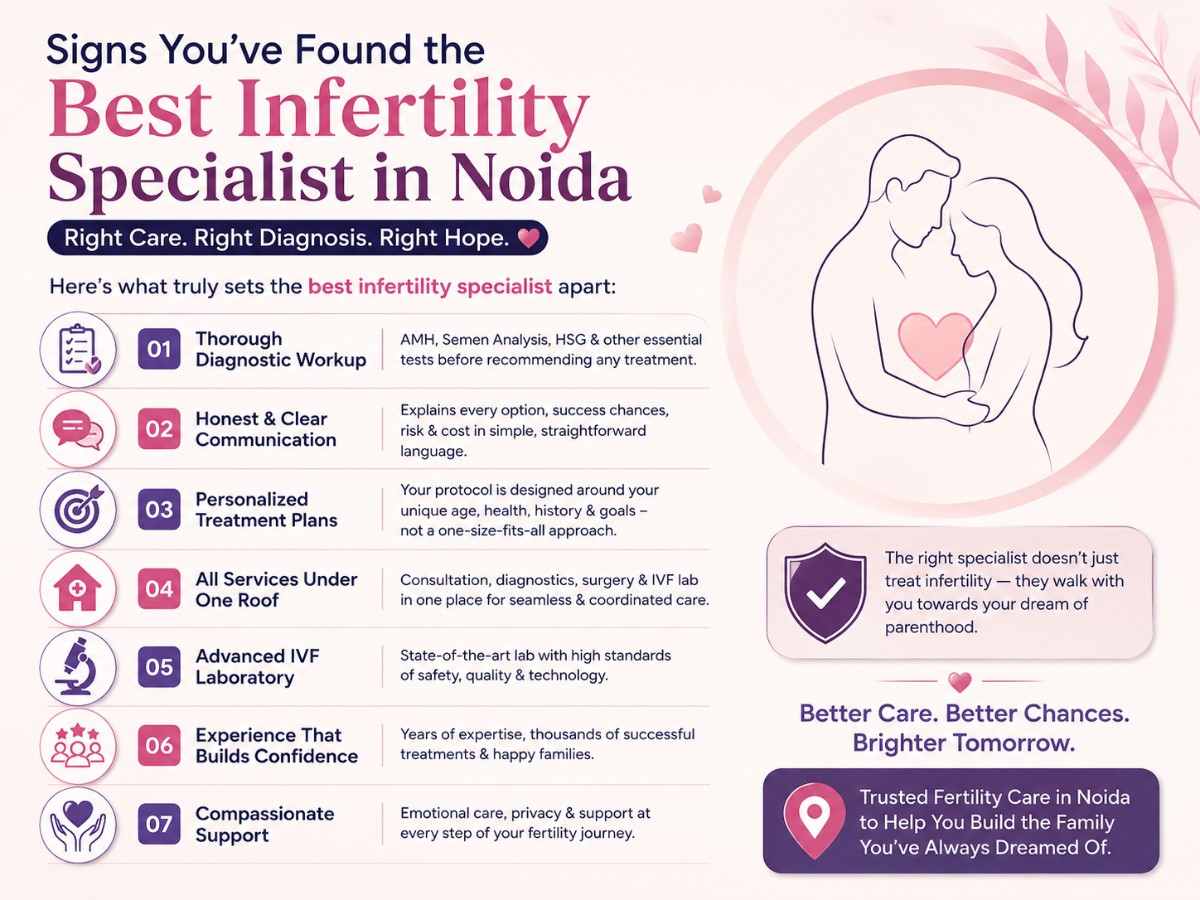
Signs You’ve Found the Best Infertility Specialist in Noida for Your IVF Journey
The best infertility specialist in Noida will run a thorough diagnostic workup (AMH, semen analysis, HSG) before recommending treatment, explain every option honestly, personalize your protocol instead of using one-size-fits-all care, and offer consultation, diagnostics, surgery, and the IVF lab under one roof.
So you’ve been Googling at 1 a.m., reading forums, and asking friends who “know someone” — and honestly, that’s completely normal. Choosing the right infertility specialist in Noida might be the single biggest decision in your entire fertility journey, bigger even than which protocol you end up on. Plus, it’s a decision most couples make while feeling exhausted, anxious, and a little bit lost. This guide walks you through exactly what separates a good clinic from a truly great one, so you can walk into your first consultation feeling informed instead of overwhelmed.
What Does a Genuinely Good Fertility Specialist Actually Do Differently?
A good infertility specialist in Noida treats the couple, not just the chart — ordering the right tests early, explaining results in plain language, and building a treatment timeline around your specific biology rather than a generic checklist.
Here’s the thing: fertility medicine isn’t one-size-fits-all, even though it can feel that way when you’re handed a printed protocol sheet within minutes of walking in. A doctor who’s genuinely good at this job will slow down. They’ll ask about your cycle history, your partner’s health, any past surgeries, and your emotional bandwidth — because all of it matters.
At Dr. Parul Agrawal Fertility in Sector 92, Noida, this shows up in a very practical way: consultation, diagnostics, surgery, and the IVF lab all sit under one roof. That’s not just convenient — it means your reports, your scans, and your treatment plan all live in one coherent story instead of being scattered across three different labs and two hospitals. Dr. Parul Agrawal brings 23+ years of clinical experience to that story, along with thousands of IVF cycles, thousands of IUI treatments, and thousands of laparoscopic and hysteroscopic surgeries behind her.
Also, watch how a doctor responds when you ask a hard question. Do they get defensive, or do they actually explain? That single interaction tells you almost everything you need to know about whether this is your best infertility specialist in Noida.
How Should Your First Consultation Actually Feel?
Your first visit should include a detailed history, a review of prior reports, and a clear diagnostic plan — not an immediate push toward IVF before anyone has confirmed why you’re struggling to conceive.
A rushed 5-minute appointment that ends in “let’s start IVF” is a red flag. Honestly, it should feel more like a conversation than a transaction. A proper first visit with a qualified infertility specialist in Noida typically includes:
- A detailed medical and menstrual history for both partners
- A review of any existing reports you bring along
- Baseline tests ordered fresh if your existing ones are outdated (usually anything older than 6–12 months)
- A realistic, written-out plan for what happens next and roughly when
So if you leave your first appointment with more questions than answers, that’s worth noticing.
Core Diagnostics: What Tests Should Actually Happen Before Treatment Begins?
Before recommending IVF, IUI, or ICSI, a thorough workup should include AMH (ovarian reserve), semen analysis, and an HSG (checking whether the fallopian tubes are open) — plus thyroid and prolactin panels where relevant.
This is where a lot of couples get shortchanged elsewhere. Skipping diagnostics and jumping straight to treatment might save time on paper, but it often means paying for the wrong protocol first. A genuinely reliable ivf treatment doctor in Noida will insist on this groundwork:
- AMH (Anti-Müllerian Hormone) test — estimates your remaining egg supply, not your egg quality
- Semen analysis — checks count, motility, and morphology; male factor plays a role in roughly 40% of infertility cases
- HSG (Hysterosalpingography) — an X-ray procedure confirming whether the fallopian tubes are open or blocked
- Thyroid (TSH) and prolactin panels — because hormonal imbalances quietly derail ovulation
- Ultrasound (antral follicle count) — a real-time look at how many follicles are available this cycle
Once these results are in, your best infertility specialist in Noida should be able to explain, in plain language, why they’re recommending IUI, IVF, or ICSI — not just that they are.
Why Does Age Matter So Much in This Conversation?
Egg quantity and quality decline gradually with age, and this decline generally becomes more noticeable after 35 — which is why timelines, and how many IUI attempts make sense before moving to IVF, shift depending on your age and ovarian reserve.
Nobody enjoys hearing this, but avoiding it doesn’t help either. IVF success rates generally decline gradually as maternal age increases, particularly past the mid-30s, mostly because egg quality changes over time. This doesn’t mean pregnancy becomes impossible — it means timelines matter more. An honest fertility specialist in Noida will tell you this directly instead of letting you assume you have unlimited time to “try naturally” first.
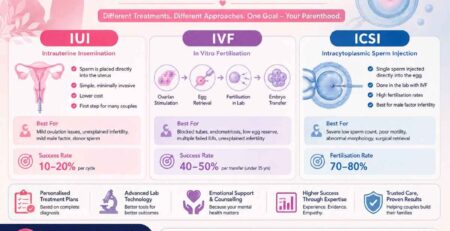
IUI vs IVF: A Side-by-Side Comparison
Here’s a clearer picture of how these two approaches actually differ, since this comparison comes up in almost every consultation:
| Factor | IUI (Intrauterine Insemination) | IVF (In Vitro Fertilization) |
| What happens | Washed sperm placed directly into the uterus | Eggs retrieved, fertilized in a lab, embryo transferred back |
| Best suited for | Mild male factor, unexplained infertility, ovulation issues | Blocked tubes, low ovarian reserve, failed IUI cycles, severe male factor |
| Typical timeline | 2–3 week cycle, minimal monitoring | 10–14 day stimulation phase + retrieval + transfer + ~2-week wait |
| Number of attempts before switching | Usually 3–4 cycles tried before moving on | Often the next step after repeated IUI failure |
| Monitoring intensity | Lower — a few ultrasound visits | Higher — frequent bloodwork and scans during stimulation |
| Cost per cycle | Lower | Higher, but often more effective per attempt depending on diagnosis |
So which one is right for you? Honestly, that depends entirely on what your diagnostics show — which loops back to why testing first matters so much, and why the right ivf treatment doctor in Noida will walk you through this table with your specific numbers, not just averages.
How Many IUI Cycles Before IVF Makes Sense?
Most fertility specialists recommend trying 3–4 IUI cycles before moving to IVF, though this shifts earlier if you’re over 35, have low ovarian reserve, or have blocked tubes.
If IUI hasn’t worked after 3–4 well-timed attempts, continuing to repeat it usually isn’t the best use of your time, money, or emotional energy. Plus, age and diagnostic findings can shorten this window considerably — a reason your ivf treatment doctor in Noida should keep revisiting your plan rather than sticking rigidly to a default number.
Common Misconceptions That Delay Real Progress
A lot of couples come in carrying myths that genuinely slow things down. Here are the big ones worth clearing up:
- Misconception 1: “IVF always works on the first try.” IVF success varies a lot by age, diagnosis, and protocol response — it’s a process, sometimes requiring more than one cycle, not a guaranteed single shot.
- Misconception 2: “Natural conception is always better to keep trying, no matter how long it takes.” Time matters biologically. Waiting years before seeking help — especially past 35 — can make treatment more complicated later.
- Misconception 3: “Male infertility isn’t a big factor.” It genuinely is, in a substantial share of cases, which is why semen analysis is a non-negotiable step, not an afterthought.
- Misconception 4: “Every clinic offers the same quality of care.” Facilities differ enormously in lab standards, protocol personalization, and how honestly they communicate. This is exactly why finding the best infertility specialist in Noida — rather than just the nearest one — genuinely changes outcomes.
Your Checklist: What to Ask Before Choosing a Fertility Specialist
Before you commit to a clinic, run through this checklist:
- Ask what diagnostics happen before any treatment is recommended. If the answer is vague, that’s a warning sign.
- Ask how many IVF cycles and IUI treatments the doctor has personally performed. Experience genuinely correlates with how confidently a doctor handles complications.
- Ask whether the lab, diagnostics, and surgical facility are on-site or outsourced. Fragmented care means fragmented communication.
- Ask how protocols are personalized, not just which “package” you’re being sold.
- Ask what happens if the first cycle doesn’t work. A thoughtful ivf treatment doctor in Noida will already have a next-step conversation ready, and a genuinely committed ivf treatment doctor in Noida won’t dodge this question.
- Ask about success rates by age group and diagnosis, not just a single blended number.
- Notice how your questions are received. Patience and clarity here usually predict what the rest of your journey will feel like.
The bottom line is: a rushed answer to any of these is worth paying attention to.
Frequently Asked Questions
Q1: How do I know if I’ve found the best infertility specialist in Noida for my situation?
Look for thorough diagnostics before treatment, clear explanations of your specific results, honest timelines, and a facility where consultation, testing, and treatment happen under one roof rather than across multiple locations. A trustworthy ivf treatment doctor in Noida will also walk you through the reasoning behind every recommendation, not just hand you a protocol sheet.
Q2: What tests should happen before starting IVF or IUI?
At minimum, expect AMH testing, semen analysis, an HSG to check the fallopian tubes, and thyroid/prolactin panels. Skipping these often leads to treatment that doesn’t match the actual problem.
Q3: How many IUI cycles should I try before moving to IVF?
Generally 3–4 cycles, though this can shorten significantly with age over 35, low ovarian reserve, or blocked tubes. A dependable Infertility Specialist in Noida should reassess after each attempt rather than defaulting to a fixed number.
Q4: Does age really affect IVF success that much?
Yes — egg quantity and quality tend to decline gradually with age, and this becomes more noticeable after the mid-30s. It doesn’t rule out success, but it does make earlier evaluation and personalized timelines more important.
Conclusion
Finding the right Infertility Specialist in Noida isn’t about picking whoever has the flashiest ad or the shortest wait time. It’s about finding someone who tests thoroughly, explains honestly, and treats your specific situation instead of a generic protocol. With 23+ years of experience, thousands of IVF cycles, thousands of IUI treatments, and thousands of laparoscopic and hysteroscopic surgeries, Dr. Parul Agrawal Fertility brings consultation, diagnostics, surgery, and the IVF lab together under one Sector 92 roof — so your entire journey stays coordinated instead of scattered. Whatever stage you’re at right now, you deserve a fertility specialist in Noida who treats your questions seriously and your timeline honestly.







Leave a Reply