
In Vitro Fertilization | Dr. Parul Agrawal
If you’re searching for the Best Fertility Specialist in Noida because natural conception hasn’t worked out even you are trying since a long period of time, In Vitro Fertilization (IVF) is the most effective fertility treatment available in today’s times— it includes fertilizing an egg with sperm outside the body and transferring the resulting embryo into the uterus. Dr. Parul Agrawal, an IVF Specialist with 23+ years of experience in Obstetrics, Gynecology, and Reproductive Medicine, has personally guided over 1,000 IVF procedures at her clinic in Sector 92, Noida. We will discuss into this what IVF is, who needs it, how it works, and what actually affects your chances of success.
What is In Vitro Fertilization?
In Vitro Fertilization, or IVF, is a fertility treatment where an egg and sperm are combined in a laboratory dish (the literal meaning of “in vitro” is “in glass”) rather than inside the body. Once fertilization happens and the embryo develops for a few days, it’s placed back into the female uterus, where it can implant and grow into a pregnancy. Honestly, it’s one of the most well-studied and hugely used Assisted Reproductive Technologies (ART) worldwide, and it’s often recommended when other treatments like medication or IUI haven’t worked then IVF is recommended as the most worked option.
Why is IVF Important? Why Does It Take Place?
IVF exists because a lot of couples in today’s times facing physical barriers into natural conception — due to blocked fallopian tubes, low sperm count, ovulation issues, or an unexplained infertility — many of these problems. Instead of depending on fertilization happening inside the fallopian tube, the lab does that step directly, which is why it works even when tubes are damaged or blocked. For couples who’ve been trying for a year or more and get no results (or six months, if the woman is over 35), IVF often becomes the most realistic path to their parenthood dream.
How the Fertility Process Takes Place
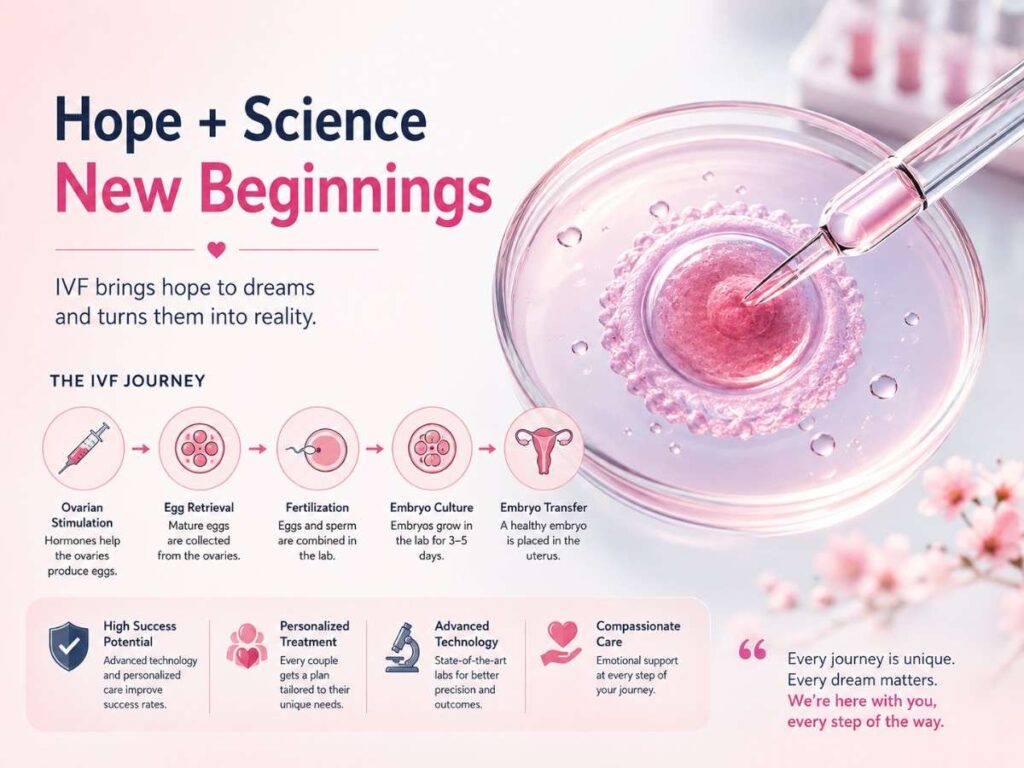
So here’s the thing — IVF isn’t a single day event, it’s a structured medical process spread across several weeks. Broadly, it involves stimulating the ovaries to produce multiple eggs, retrieving those eggs, fertilizing them in a lab, growing the embryos for a few days, and then transferring the healthiest one (or two) back into the females uterus. Every stage is closely monitored through blood tests and ultrasounds, so the treatment plan can be adjusted in real time based on how your body is reacting toward the process.
Who Needs IVF?
IVF is typically recommended for:
- Women with blocked, damaged, or removed fallopian tubes
- Couples dealing with male factor infertility (low sperm count, poor motility, or abnormal morphology)
- Women with ovulation disorders like PCOS that haven’t responded to other treatments
- Women above 35+ with declining ovarian reserve
- Couples with unexplained infertility after thorough investigation
- Women with endometriosis affecting fertility
- Couples who’ve had repeated failed IUI cycles
- Individuals or couples requiring donor eggs, donor sperm, or a gestational surrogate
- Couples wanting to use pre-implantation genetic testing to avoid passing on inherited conditions
If you’re a woman above 35, or your partner has male infertility concerns, it’s worth consulting a Fertility Specialist in Noida early rather than waiting, since egg quality and quantity decline with age.
The IVF Process — Step by Step
Step 1: Ovarian Stimulation Hormonal injections are given for about 8-12 days to encourage the ovaries to produce multiple mature eggs instead of the usual one per cycle. Regular ultrasounds and blood tests track the follicle growth of process.
Step 2: Egg Retrieval Once follicles reach the right size, a minor procedure under sedation is done to collect the eggs directly from the ovaries using a fine needle using by ultrasound. It usually takes 15-20 minutes process.
Step 3: Sperm Collection and Fertilization A semen sample is collected the same day (or donor/frozen sperm is used), and the eggs are fertilized in the lab either by mixing eggs and sperm together, or through ICSI, where a single sperm is injected directly into an egg.
Step 4: Embryo Culture The fertilized eggs are monitored in the lab for 3-5 days as they divide and grow. Embryologists track development of egg to identify the most healthiest embryos.
Step 5: Embryo Transfer One or two of the best-quality embryos are transferred into the uterus using a thin catheter — this is a quick, usually painless procedure that doesn’t even need anaesthesia at all.
Step 6: The Two-Week Wait and Pregnancy Test About 10-14 days after transfer, a blood test checks for pregnancy hormone levels. If additional healthy embryos remain, they can be frozen for later future purpose .
Benefits of IVF
- It Works even when fallopian tubes are blocked in female bodies.
- Allows genetic screening of embryos before transfer
- It Gives couples the option to use donor eggs, donor sperm, or a surrogate if they want.
- Higher success rates per cycle compared to many other fertility treatments due to age factor
- Allows fertility preservation through egg or embryo freezing
- Gives doctors accurate control and monitoring of each stage of conception.
IVF Success Rate: What Affects Success
IVF success isn’t a fixed number — it majorly depends on age, egg and the sperm quality, the root cause of infertility, and the clinic’s lab standards. According to data referenced by organizations like the Indian Society for Assisted Reproduction (ISAR) and global reporting bodies, success rates are generally highest in women under 35 and decline gradually with the age, particularly after 40. The World Health Organization (WHO) also notes that infertility affects a major proportion of couples globally, which is part of why ART treatments like IVF have become adopted hugely. Rather than fixating on a single statistic, it’s more helpful to discuss your specific case with a Fertility Specialist in Noida who can assess your individual profile properly and deeply.
Factors that influence success rate include:
- The Woman’s age and ovarian reserve as healthier the most healthy result you will get.
- Sperm quality and count in male partner, if male partner have low sperm quality it decreases the chances.
- Embryo quality and genetic health of patients.
- Uterine lining thickness and receptivity in female bodies.
- Underlying conditions like endometriosis or PCOS if you were suffering from these in your past.
- Lifestyle factors — smoking, weight, and stress management if you smoke.
Myth vs Fact: Common IVF Misconceptions
Myth: IVF always results in twins or triplets.
Fact: While multiple embryo transfers can increase the chance of twins, most modern IVF protocols goes in the favour of single embryo transfer specifically to reduce this risk and support a healthier pregnancy.
Myth: IVF guarantees pregnancy.
Fact: No fertility treatment can guarantee you a pregnancy — IVF majorly improves the problems for many patients, but success depends on individual health factors.
Myth: IVF babies are less healthy than naturally conceived babies.
Fact: Research over decades has generally found IVF-conceived children to be as healthy as naturally conceived children, with routine monitoring throughout pregnancy.
Why Choose Dr. Parul Agrawal for IVF in Noida
Dr. Parul Agrawal brings 23+ years of dedicated experience in Obstetrics, Gynecology, and Reproductive Medicine, and has personally performed over 1,000 IVF procedures, 1,000+ IUI treatments, and 1,000+ laparoscopic surgeries. What makes her different as the Best Fertility Specialist in Noida isn’t just the count of cases — it’s the patient-first approach, where every treatment plan is customized based on individual diagnosis rather than a common treatment protocol. Based in Sector 92, Noida, her clinic combines clinical expertise with compassionate, clear communication, so patients always understand what’s happening and why at each stage. This content has been reviewed by Dr. Parul Agrawal to makes the medical accuracy.
We also provide IUI (Intrauterine Insemination) treatment for couples who may benefit from a less invasive option before moving directly to IVF, as well as laparoscopic surgery for conditions like endometriosis or fibroids that can affect fertility — so if you’re exploring your options, it’s worth asking about these during your consultation.
Cost Factors for IVF
IVF costs differs from patient to patient, so it’s best to avoid comparison based on numbers you’ve heard elsewhere. Broadly, the following factors influence the cost:
- Number of IVF cycles needed as some conceive in their first cycle other needs two or more.
- Use of additional techniques like ICSI or genetic testing.
- Medication dosage and duration of stimulation
- Need for donor eggs, donor sperm, or a surrogate.
- Embryo freezing and storage, if applicable
- Diagnostic tests and pre-treatment evaluations
A detailed, customized calculated cost estimate the best discussed directly during a consultation with your fertility specialist.
Frequently asked questions
1. How long does one IVF cycle take?
A single IVF cycle, from ovarian stimulation to embryo transfer, typically takes about 4-6 weeks, though timelines differ slightly by patient.
2. Is IVF painful?
Most steps involve minimal discomfort rather than a major pain — egg retrieval is done under sedation, and embryo transfer is generally described as similar to a routine pelvic exam, it is not that much painful and it is bearable.
3. What is the right age for IVF?
IVF can be done at various ages, but success rates are generally higher in women under 35. Women above 35+ are still the strong candidates, though outcomes may differ based on their ovarian reserve due to their age factor.
4. Can IVF fail? What happens then?
Yes, not every cycle results in pregnancy. If a cycle fails, your doctor will review the response and may adjust the treatment, use frozen embryos if available, or recommend further testing before the next attempt taken.
5. Is ICSI different from IVF?
ICSI is a technique used within an IVF cycle where a single sperm is injected directly into an egg, typically recommended for male factor infertility, rather than being a separate treatment altogether.
6. How many embryos are transferred at once?
Most clinics today recommend transferring one, sometimes two, embryos per cycle to balance success rates with the health risks of multiple pregnancies.
7. Do IVF injections have side effects?
Some women experience bloating, mood changes, or minimal discomfort during the stimulation phase — these are usually temporary and monitored closely by your doctor.
8. Can lifestyle changes improve IVF success?
Yes, maintaining a healthy weight, avoiding smoking, managing stress, and following your doctor’s treatment guidance can majorly support the better outcomes.
Ready to Take the Next Step?
If you’ve been trying to conceive without success, don’t wait longer than needed— early consultation often makes a real difference. Book a consultation with Dr. Parul Agrawal, the Best Fertility Specialist in Noida, at her Sector 92 clinic today, and get a customized fertility assessment designed around your specific situation