
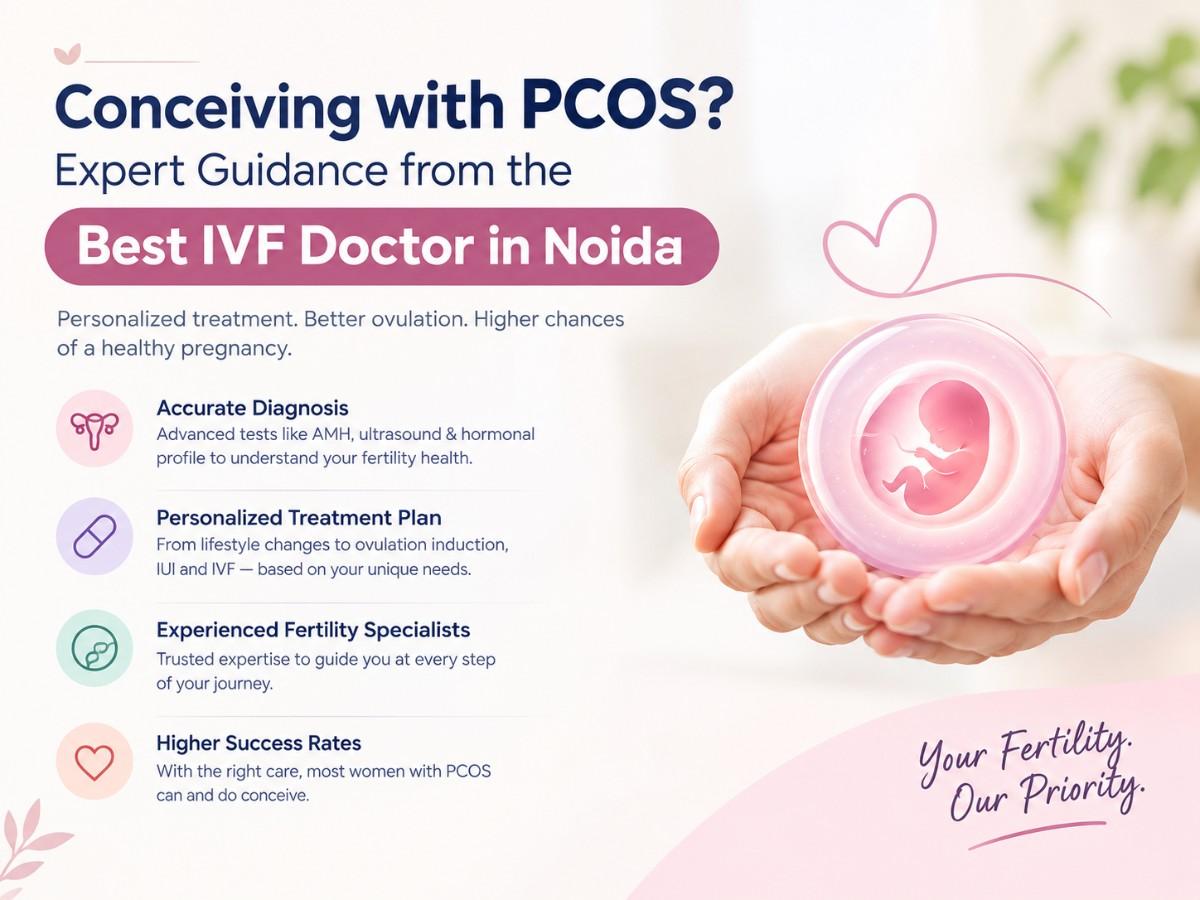
Conceiving with PCOS: Expert Solutions from the Best IVF Doctor in Noida
PCOS makes conception harder because it disturbs the regular ovulation, but it hardly makes the pregnancy impossible. With the right diagnosis, lifestyle changes, and a customized protocol from the Best IVF Doctor in Noida, most women with PCOS do go on to have healthy pregnancies.
If you’ve just been told you have PCOS and you’re trying to conceive, take a breath. Honestly, this is one of the most common and most treatable issue of fertility struggles we see. Polycystic Ovary Syndrome affects nearly 1 in 5 women of reproductive age in India, and yet so many patients walk into our Sector 92 clinic thinking that a PCOS diagnosis is the end of the road. It isn’t. It’s just a common problem that needs the right map.
At Dr. Parul Agrawal Fertility, we’ve guided thousands of couples through exactly from this journey. Dr. Parul Agrawal brings 23+ years of clinical experience to every consultation, and her team has performed thousands of IVF cycles, thousands of IUI treatments, and thousands of laparoscopic and hysteroscopic surgeries — many of them specifically for PCOS-related infertility. So when people search for the Best Fertility Clinic in Noida, what they’re really looking for is a place that treats the whole picture, not just the ovaries problem a single problem only. In our experience, patients who research carefully before their first appointment — reading up on protocols, asking around, comparing options for the Best IVF Doctor in Noida — tend to feel calmer and more in control once treatment actually begins.
Why does PCOS make it harder to conceive?
PCOS throws off the hormonal signals your ovaries need to release an egg every month. Instead of one dominant follicle maturing and ovulating, many small follicles stay stuck in development — which means ovulation becomes irregular or stops altogether.
PCOS isn’t really an “ovary problem” on its own. It’s a hormonal and metabolic condition that happens to show up loudest in your menstrual cycle. Elevated androgens (male hormones like testosterone), insulin resistance, and irregular LH-to-FSH ratios all interfere with the normal process of one egg maturing and being released each month.
So instead of ovulating regularly, many women with PCOS ovulate rarely, unpredictably, or not at all. No ovulation means no egg available to be fertilized, which is the main reason of conception becomes difficult. Plus, insulin resistance — which shows up in a large number of PCOS cases — can further disorder the hormone balance and make weight management frustratingly hard, which loops back and affects fertility again.
Diagnosis typically starts with a few key tests:
- AMH (Anti-Müllerian Hormone): gives us a sense of ovarian reserve and helps confirm the PCOS picture, since AMH tends to run higher in PCOS patients
- Pelvic ultrasound: checks for the classic “string of pearls” follicle pattern and measures follicle count
- Hormonal panel: LH, FSH, testosterone, and thyroid levels, since thyroid issues often overlap with PCOS
- HSG (Hysterosalpingogram): confirms your fallopian tubes are open, especially before starting IUI
- Semen analysis: for your partner, because fertility is always a two-person equation
Any Fertility Specialist in Noida worth consulting will insist on this full workup before recommending a treatment path — not just an ultrasound and a prescription. This is also where the difference between an average clinic and the Best Fertility Clinic in Noida becomes obvious — a thorough workup upfront saves months of guesswork later.
How is PCOS-related infertility actually treated?
Treatment usually moves in stages — lifestyle changes first, then ovulation-induction medication, then IUI, and IVF if those steps don’t lead to pregnancy within a reasonable window. Most patients don’t need to start at IVF.
Honestly, this surprises a lot of people. PCOS treatment for fertility almost never starts with IVF. It usually starts much simpler.
- Step 1: Lifestyle and metabolic correction. Even a 5–10% reduction in body weight can restore ovulation in many PCOS patients, because it improves insulin sensitivity. We often pair this with metformin if insulin resistance is significant.
- Step 2: Ovulation induction. Medications like letrozole (often the first choice now, ahead of the older clomiphene citrate) are used to trigger the release of a mature egg. This is typically tried for 3–4 cycles, with cycle monitoring through ultrasound to confirm ovulation is actually happening and time intercourse or IUI accordingly.
- Step 3: IUI (Intrauterine Insemination). If ovulation induction alone isn’t leading to pregnancy, we combine it with IUI — placing washed, concentrated sperm directly into the uterus around the time of ovulation. Most fertility specialists, including our team at the Best Fertility Clinic in Noida, recommend trying 3–4 IUI cycles before considering IVF, since success rates per cycle are modest but cumulative success improves with a few attempts. This is a good moment to be working with the Best Fertility Specialist in Noida you can find, since the decision to switch from IUI to IVF should be based on your specific response, not a rigid timeline.
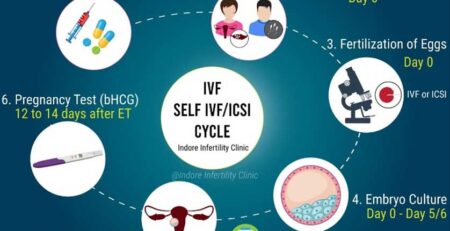
- Step 4: IVF (In Vitro Fertilization). If IUI cycles don’t work, or if there are additional factors — like blocked tubes, male factor infertility, or age above 35 — IVF becomes the more efficient path. A typical IVF cycle for PCOS involves a 10–14 day stimulation phase (carefully dosed, because PCOS patients respond strongly to stimulation medication and need close monitoring to avoid ovarian hyperstimulation), egg retrieval, fertilization in the lab, and embryo transfer, followed by the well-known ~2-week wait before a pregnancy test.
IUI vs IVF for PCOS: which path fits you?
| Factor | IUI | IVF |
| Best suited for | Irregular ovulation, open tubes, mild male factor | Blocked tubes, significant male factor, failed IUI cycles, age 35+ |
| Typical cycles before switching | 3–4 cycles | Often achieves pregnancy in fewer cycles when indicated |
| Procedure complexity | Simple, outpatient, minimal downtime | Multi-step: stimulation, retrieval, lab fertilization, transfer |
| Monitoring intensity | Moderate — a few ultrasound visits per cycle | High — daily/alternate-day monitoring during stimulation |
| Approximate timeline per attempt | 2–3 weeks | 4–6 weeks including the 2-week wait |
| Cost | Lower per cycle | Higher per cycle, but often more efficient overall |
So which one is right for you? Honestly, it depends on your age, how long you’ve been trying, your AMH and antral follicle count, and whether there’s any additional factor like tubal blockage or male infertility. This is exactly the kind of decision that benefits from sitting down with a genuine Fertility Specialist in Noida who looks at your full file — not just your cycle history. Ask any Best IVF Doctor in Noida and they’ll tell you the same thing: this decision should never be made from a chart alone.
What are the biggest myths about PCOS and fertility?
The biggest misconception is that PCOS equals infertility. It doesn’t. Most women with PCOS conceive naturally or with minimal intervention once ovulation is restored — IVF is a later-stage option, not the default starting point.
- Myth 1: “PCOS means you can’t get pregnant naturally.” Not true. Many women with PCOS conceive on their own once ovulation is regulated through weight management, metformin, or ovulation-induction medication. IVF is reserved for cases where simpler treatments haven’t worked.
- Myth 2: “Every PCOS cyst needs to be removed.” Those aren’t true cysts — they’re small, immature follicles. Surgery (like laparoscopic ovarian drilling) is only used in specific, resistant cases, not as a routine step.
- Myth 3: “Losing weight alone will fix everything.” Weight matters, but it’s one piece. Insulin resistance, thyroid function, LH/FSH balance, and even stress all play a role. Treating PCOS for fertility means addressing the whole hormonal picture, not just the scale.
- Myth 4: “IVF success is guaranteed once you start.” No responsible clinic — including any genuine Best IVF Doctor in Noida — will promise a guaranteed outcome. Success depends on age, egg quality, embryo quality, and uterine receptivity. What a good clinic can promise is a carefully personalized protocol and honest communication at every step.
What should you ask before choosing a fertility specialist?
Before committing to treatment, ask about the doctor’s specific experience with PCOS cases, the clinic’s IVF lab standards, transparent cost breakdowns, and whether diagnostics, surgery, and the IVF lab are all handled in-house.
Choosing where to start treatment is a big decision, so here’s a practical checklist to use while comparing the Best Fertility Clinic in Noida options in front of you:
- How many years of experience does the doctor have with PCOS-specific fertility cases? Look for someone who has handled a genuinely high volume — Dr. Parul Agrawal, for instance, brings 23+ years of hands-on clinical experience to this exact question, which is precisely why so many patients consider her the Best Fertility Specialist in Noida for complex PCOS cases.
- Are diagnostics, surgery, and the IVF lab all under one roof? At our Sector 92 facility, consultation, testing, laparoscopic or hysteroscopic surgery, and the embryology lab are all handled in-house, which cuts down on delays and miscommunication between providers.
- What’s the clinic’s approach to ovarian hyperstimulation risk in PCOS patients? This matters a lot, since PCOS ovaries respond more sensitively to stimulation medication.
- Is the cost breakdown transparent upfront? Ask for a written estimate covering diagnostics, medication, and procedure fees before you commit.
- Does the team explain the “why” behind each recommendation? A trustworthy Fertility Specialist in Noida will walk you through your specific hormone numbers and follicle counts, not just hand you a prescription.
- What support exists between appointments? Ongoing monitoring during stimulation cycles requires quick answers, not long waits for a callback.
Plus, don’t underestimate the value of simply feeling heard. Fertility treatment is stressful enough without a rushed, transactional experience.
Frequently Asked Questions
Can women with PCOS get pregnant without IVF?
Yes. Most women with PCOS conceive through lifestyle changes, ovulation-induction medication, or IUI. IVF becomes relevant mainly when these steps don’t lead to pregnancy within a reasonable timeframe, or when additional factors are present.
How long should we try before seeing a fertility specialist for PCOS?
If your periods are irregular or you haven’t conceived after 6 months of trying (or 12 months if cycles are regular), it’s time to consult a specialist. Don’t wait longer just because you’re young — irregular ovulation needs attention regardless of age. Booking early with the Best Fertility Specialist in Noida you can find gives you more treatment options, not fewer.
Does PCOS affect IVF success rates?
PCOS patients often have a good egg reserve, which can work in their favor during IVF. The main challenge is careful stimulation management to avoid over-response, not a lack of eggs. With the right protocol from an experienced Best IVF Doctor in Noida, outcomes are often comparable to non-PCOS patients of the same age.
Is Dr. Parul Agrawal Fertility a good option for PCOS treatment in Noida?
Dr. Parul Agrawal brings 23+ years of experience and has overseen thousands of IVF cycles, thousands of IUI treatments, and thousands of laparoscopic and hysteroscopic surgeries at the Sector 92 clinic, where consultation, diagnostics, surgery, and the IVF lab all operate under one roof — a big part of why patients call it the Best Fertility Clinic in Noida and why so many refer to Dr. Agrawal as the Best Fertility Specialist in Noida for their PCOS journey.
Conclusion
A PCOS diagnosis is a starting point for treatment, not a stopping point for your family plans. So take the diagnostics seriously, ask good questions, and work with a team that treats your specific hormonal picture rather than a generic protocol. If you’re searching for the Best Fertility Specialist in Noida or comparing options for the Best Fertility Clinic in Noida, the most important thing to look for is a clinic that combines real clinical depth with a genuinely warm, patient-first approach — which is exactly what we aim to offer every couple who walks through our doors at Dr. Parul Agrawal Fertility.





Leave a Reply