
What Tests Are Done Before Starting IVF? A Complete Guide
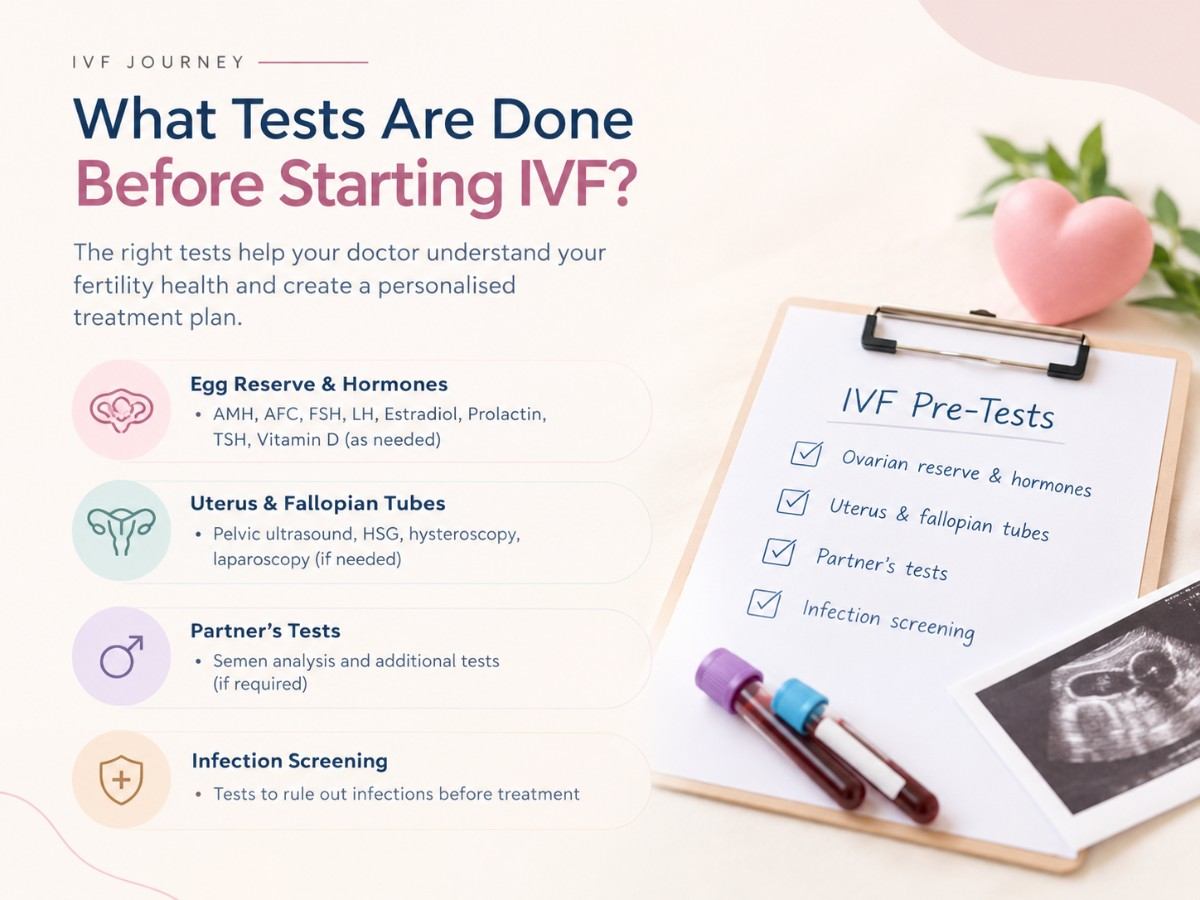
Before IVF, doctors typically check ovarian reserve (AMH, AFC), the tubes and uterus (HSG, ultrasound, hysteroscopy), hormones, semen quality, and infection screens. These tests show why pregnancy hasn’t happened and help your doctor choose the right protocol and dose.
You booked the consultation. Then your doctor says, “Let’s run a few tests first,” and your mind starts racing. Which tests? Will they hurt? How long until you start?
Take a breath. Honestly, this stage is the gentlest part of the journey. Testing replaces guesswork with answers. So if you’ve typed “Best Infertility Specialist in Noida” into Google late at night, you’re probably hoping for exactly that: a clear plan you can trust. At Dr. Parul Agrawal Fertility in Sector 92, Dr. Parul Agrawal brings 23+ years of experience to this first step and explains every result in plain language.
Why do I need tests before IVF at all?
Tests find the actual reason pregnancy hasn’t happened, so your IVF plan fits your body instead of a generic template. They also flag problems, like a blocked tube or low sperm count, that can change the treatment you need.
Here’s the thing: IVF isn’t one single treatment. It’s a family of protocols, such as antagonist, long agonist, and mild stimulation, and your results decide which one suits you. Skip the workup and you risk the wrong medication dose, a cancelled cycle, or months of lost time.
Plus, some couples find a simpler fix along the way. A small uterine polyp comes out during a short hysteroscopy, and natural conception or IUI may suddenly become possible. That’s why the “Best IVF Doctor in Noida” for you is someone who tests thoroughly first and recommends IVF only when it makes sense.
Which tests check my egg reserve and hormones?
Doctors check ovarian reserve with an AMH blood test and an antral follicle count (AFC) on ultrasound. Early-cycle blood work measures FSH, LH, estradiol, prolactin, and thyroid (TSH), showing how your ovaries respond and how much medication you may need.
- AMH (Anti-Müllerian Hormone): This blood test works on any cycle day. It estimates how many eggs remain, but it says nothing about egg quality.
- Antral follicle count (AFC): A transvaginal ultrasound early in your cycle counts the small resting follicles in both ovaries.
- Day 2–3 hormones: FSH, LH, and estradiol show how hard your body has to push your ovaries.
- Prolactin and TSH: High prolactin or a sluggish thyroid can disrupt ovulation, and doctors can treat both.
- Extras when needed: Vitamin D, fasting glucose or HbA1c, and testosterone if PCOS is a possibility.
Honestly, a low AMH doesn’t mean you can’t conceive. It means your doctor plans differently, sometimes with a higher stimulation dose or a tighter timeline. Anyway, treat the number as a guide, never a verdict. The “Best IVF Doctor in Noida” reads AMH alongside your age, your scan, and your history.
Which tests check my uterus and fallopian tubes?
A pelvic ultrasound checks the uterus and ovaries. An HSG (hysterosalpingography) X-ray shows whether the tubes are open, and hysteroscopy lets the doctor see inside the uterine cavity directly. Together they catch fibroids, polyps, adhesions, and blocked tubes.
- Pelvic ultrasound: Your doctor looks for fibroids, cysts, and lining thickness.
- HSG: Dye travels through your cervix, and an X-ray shows whether it spills freely from the tubes. You book it after your period ends and before ovulation. It takes about 10–15 minutes, and you’ll feel period-like cramps.
- Hysteroscopy: A thin camera looks inside the uterus. If the doctor spots a polyp, adhesion, or septum, they can often treat it in the same sitting.
- Laparoscopy: Doctors suggest it only when they suspect endometriosis or a fluid-filled tube (hydrosalpinx), which can lower IVF success if left alone.
Also, a fertility specialist in Noida who operates as well as treats can act on these findings fast. Dr. Parul Agrawal has performed thousands of laparoscopic and hysteroscopic surgeries. Consultation, diagnostics, surgery, and the IVF lab all sit under one roof in Sector 92, so you don’t carry a folder of reports between hospitals. If you’re comparing options for the Best Fertility Specialist in Noida, ask whether that continuity exists.
What tests does my partner need?
Semen analysis is the first and most important male test. It checks sperm count, motility, and morphology after 2–5 days of abstinence. Depending on results, doctors may add hormone tests, a repeat analysis, DNA fragmentation testing, or a scrotal ultrasound.
Yes, he needs testing. Male factors play a role in a significant share of infertility cases. The test takes one sample and about 30 minutes. Doctors often repeat it after a few weeks, because illness, stress, and heat can swing sperm counts.
So results steer the lab method too. Severe male factor often points to ICSI, where an embryologist injects a single sperm into each mature egg. Honestly, this is where a Best Infertility Specialist in Noida earns trust: by treating the couple, not just the woman.
What screening and general health tests come next?
Both partners usually get blood group and Rh typing, CBC, blood sugar, thyroid, and infectious disease screening (HIV, hepatitis B and C, syphilis). Women may also need rubella immunity and Pap smear checks. These protect your health, the pregnancy, and the lab.
These feel routine, yet they matter. Rubella immunity tells your doctor whether you need a vaccine before pregnancy. Blood sugar and thyroid levels affect ovulation and early pregnancy.
If you’ve had recurrent miscarriages or your family carries a genetic condition, your doctor may add a karyotype or carrier screening. Not everyone needs these, and a good doctor orders them for a reason, not by default. Plus, a Best Infertility Specialist in Noida tells you why each test sits on your list.
How do these tests compare at a glance?
Most tests fit into one to two menstrual cycles. Blood tests are quick, ultrasound and semen analysis take under an hour, and HSG or hysteroscopy need timing around your period. This table shows who takes each test and what it tells you.
| Test | Who | What it checks | Typical timing | What to expect |
| AMH | Woman | Egg reserve (quantity) | Any cycle day | Simple blood draw |
| Antral follicle count | Woman | Resting follicles in ovaries | Early cycle | Quick vaginal ultrasound |
| FSH, LH, estradiol | Woman | Ovarian response | Day 2–3 | Blood draw |
| HSG | Woman | Tube openness, uterine shape | After period, before ovulation | 10–15 minutes, cramps |
| Hysteroscopy | Woman | Polyps, adhesions, septum | After period ends | Short procedure |
| Semen analysis | Man | Count, motility, morphology | After 2–5 days abstinence | One sample, ~30 minutes |
| Infection screen | Both | HIV, hepatitis B/C, syphilis | Any time | Blood draw |
Should I try IUI first, or go straight to IVF?
Doctors typically try three to four IUI cycles before moving to IVF when tubes are open and semen parameters are adequate. Blocked tubes, severe male factor, or advancing age may sometimes justify moving faster.
Your results answer this question. Open tubes, healthy semen, and mild or unexplained infertility often start with IUI. Blocked tubes, low sperm counts, or reduced ovarian reserve point toward IVF or ICSI. Age matters too, because IVF success generally declines gradually after 35, so doctors weigh how long you’ve already waited.
Honestly, nobody can promise an outcome. When you compare candidates for Best Fertility Specialist in Noida, notice who talks in ranges and who talks in guarantees. The “Best IVF Doctor in Noida” for your case will show you the results behind every recommendation.
What do people get wrong about pre-IVF tests?
Four myths trip people up: that normal reports mean nothing is wrong, that AMH predicts pregnancy, that only women need testing, and that testing delays treatment. All four are false, and a thorough workup usually saves time.
- “Normal reports mean nothing is wrong.” Sometimes every test looks normal and pregnancy still doesn’t happen. Doctors call that unexplained infertility, and it’s common. Normal results still help, because they rule out fixable causes.
- “AMH tells me if I’ll get pregnant.” It counts eggs. It doesn’t judge quality or promise anything.
- “Only the woman needs testing.” Sperm problems can hide behind a perfectly healthy partner’s reports.
- “Testing delays treatment.” Most workups fit in one to two cycles, and skipping them often costs far more time later.
So a Best Infertility Specialist in Noida should gently push back on all four.
How do I pick a fertility clinic I can trust?
Look for in-house diagnostics, a surgeon who operates in-house, an on-site IVF lab, protocols tailored to your results, honest success ranges by age, and transparent costs. Ask these questions at your first consultation, and trust the clinic that answers plainly.
Searching for the “Best IVF Doctor in Noida” or the “Best Fertility Specialist in Noida” returns a long list. Use this checklist to cut through it.
- Does the clinic run diagnostics in-house?
- Who performs surgery if my tests reveal a problem?
- Does the clinic have its own IVF lab?
- Will you explain every result and why you chose my protocol?
- How do you talk about success rates? Look for age-based ranges. Run from guarantees.
- What will each step cost?
Dr. Parul Agrawal Fertility keeps consultation, diagnostics, surgery, and the IVF lab under one roof in Sector 92. Behind that sit 23+ years of experience, thousands of IVF cycles, thousands of IUI treatments, and thousands of laparoscopic and hysteroscopic surgeries. Whoever becomes your Best Infertility Specialist in Noida should welcome every question on this list.
Frequently Asked Questions
What tests are done before IVF?
Women usually get AMH, AFC, hormone tests (FSH, LH, estradiol, prolactin, TSH), a pelvic ultrasound, and often an HSG or hysteroscopy. Men get a semen analysis. Both partners get blood group, blood sugar, and infectious disease screening. Your doctor adds tests based on your history.
How long does the pre-IVF workup take?
Most couples finish in one to two menstrual cycles, because some tests need specific cycle days. Blood draws and scans take minutes, an HSG takes 10–15 minutes, and a semen analysis takes about 30 minutes. Extra tests can add a few weeks. Ask the “Best IVF Doctor in Noida” you choose to map out your calendar.
Can I still do IVF with a low AMH?
Often, yes. Low AMH means fewer eggs, not zero chance. Your doctor adjusts the protocol, medication dose, and timeline, and reads AMH alongside your age and AFC. A Best Fertility Specialist in Noida never treats one number as the final word.
Do both partners need testing before IVF?
Yes. Male factors contribute to a significant share of infertility cases, and results guide the lab method, such as conventional IVF or ICSI. A Best Infertility Specialist in Noida evaluates the couple together so nothing gets missed.
What should I do next?
Book a consultation, bring any previous reports, and ask for a complete workup for both partners. Most tests fit within one to two cycles, and the results give you a clear roadmap. You don’t need to decide about IVF until you see them.
Conclusion
is this: tests aren’t a hurdle, they’re a map. Whether you’re still gathering names for the Best Fertility Specialist in Noida or ready to book, choose the team that explains your results clearly, tests both partners, and never promises the impossible. And when you weigh the Best IVF Doctor in Noida against every other option, pick the one who makes you feel heard.









Leave a Reply