
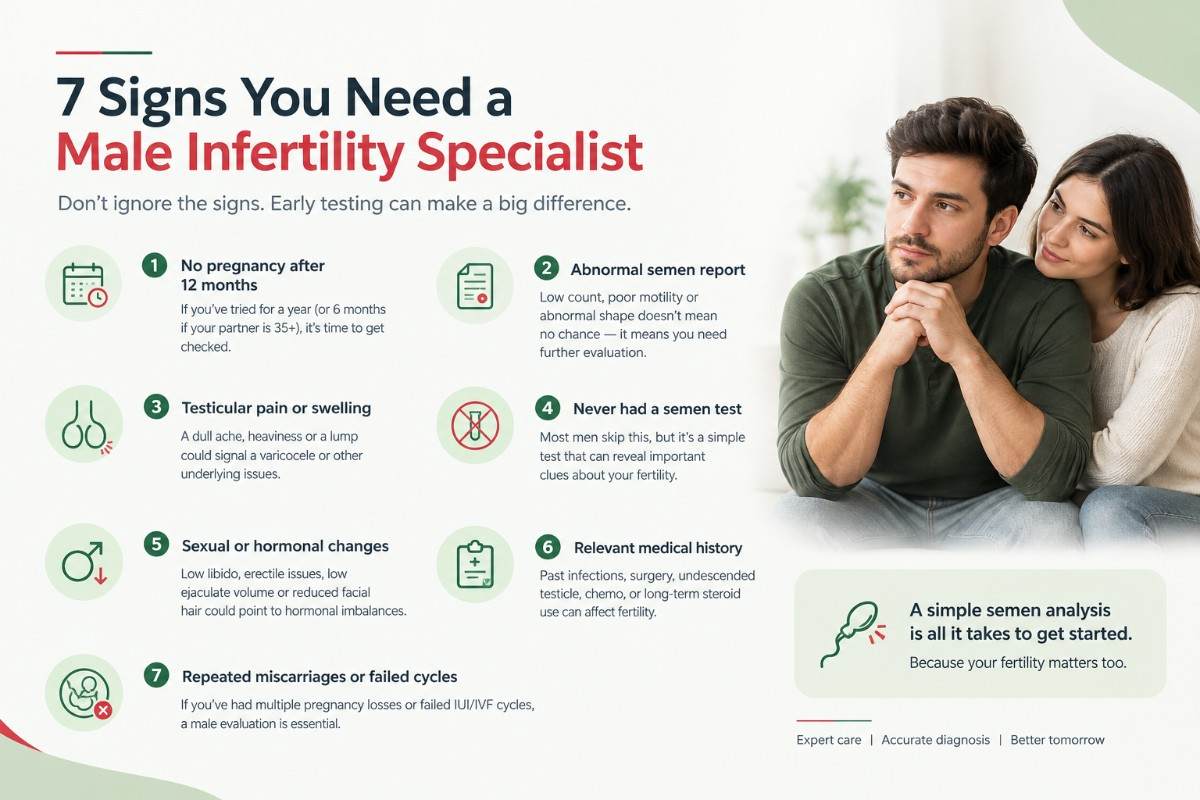
7 Signs You Need a Male Infertility Specialist (Number 4 Is Ignored by Most Men)
Male factors contribute roughly around 40-50% of infertility cases. See a specialist if you’ve tried for 12 months (or 6 if your partner is 35+), have an abnormal semen report, testicular pain, or sexual difficulties. Early testing takes only one simple semen analysis of mens.
Honestly, most couples walk into a fertility clinic assuming that the problem is only in the female body. So she gets every test, he stays home, and months slip by doing this. Here’s the thing: men play a role all of the cases. If you’re quietly wondering whether you should get checked or not, take a breath. Many male causes respond well to treatment.
At Dr. Parul Agrawal Fertility in Sector 92, Noida, Dr. Parul Agrawal brings 23+ years of experience, thousands of IVF cycles, thousands of IUI treatments, and thousands of laparoscopic and hysteroscopic surgeries. Delaying the male check-up remains one of the most common ways couples lose their precious time to become parenthood. Anyway, let’s fix that. If you’re searching for the best male infertility treatment in Noida, or just want to know whether your situation counts, the seven signs below will help you decide.
What is actually happening inside male fertility?
Sperm take about 72-74 days to develop, so today’s semen quality reflects the last three months of your health. A fertility specialist tests count, motility, and shape, then checks hormones and anatomy to find out why numbers fall short.
Think of sperm production as a three-month factory cycle. Your testicles make sperm, the epididymis matures them, and the vas deferens carries them out. Heat, infection, hormones, or a blockage can disrupt any step. So a high fever or a rough illness can show up on a report weeks later.
A proper workup usually includes:
- Semen analysis after 2-5 days of abstinence, repeated after 2-3 months if abnormal.
- Hormone panel covering FSH, LH, testosterone, and prolactin.
- Scrotal Doppler ultrasound to spot a varicocele.
- Sperm DNA fragmentation test when miscarriages or failed cycles have happened.
- Genetic tests (karyotype, Y-chromosome microdeletion) for many cases.
Also, a semen analysis points you toward a diagnosis but doesn’t make one. That’s why a Fertility Specialist in Noida who reads your report alongside your history, examination, and scans matters. Plus, male infertility treatment ranges from lifestyle changes and medicines to microsurgery and ICSI, and the right choice depends overly on the causes.
What are the 7 signs you need a male infertility specialist?
See a specialist if you’ve had no pregnancy after 12 months, an abnormal semen report, testicular pain or swelling, never had a semen test, sexual changes, related medical history, or repeated miscarriages or failed IUI/IVF cycles. Any single sign justifies a consultation as soon as possible.
- You’ve tried for 12 months without a pregnancy. Doctors define infertility as 12 months of regular unprotected intercourse without conception. If your partner is 35 or older, don’t wait more than 6 months. Time matters a lot in pregnancy cases, especially for women in their 30s, so test both of you at the same time as soon as posisble.
- Your semen analysis came back abnormal. The WHO 2021 lower reference limits include a concentration of 16 million/mL and progressive motility of 30%. Low numbers don’t mean “no chance.” They mean you need context and a repeat test in 2-3 months, and pregnancy still possible.
- You feel pain, swelling, or a lump in your testicles. A dull ache, a heavy feeling, or a “bag of worms” texture often signals a varicocele, which is an enlarged vein that overheats the testicle. It appears in about 15% of men and up to 40% of men with primary infertility. Microsurgical varicocelectomy often helps.
- You’ve never had a semen analysis at all. This is the one of the step which most men skip. “I’m healthy and my sex life is fine, so I’m fine” feels logical, but normal erections say nothing about sperm count or quality. Some men have no sperm in the ejaculate and never feel a thing. Embarrassment drives most of this avoidance. Yet the test takes about 30 minutes, and it can save you a year of guessing, why pregnancy don’t happens.
- You notice sexual or hormonal changes. Low libido, erectile difficulty, very low ejaculate volume, or reduced facial hair can point to low testosterone or high prolactin. Both are treatable.
- Your history includes red flags. Think undescended testicle in childhood, mumps after puberty, hernia or groin surgery, testicular torsion, chemotherapy, sexually transmitted infections, or long-term steroid use. Prolonged heat exposure counts too.
- You’ve had repeated miscarriages or failed IUI/IVF cycles. High sperm DNA fragmentation can cause poor embryo quality or early pregnancy loss. So before repeating a cycle, ask whether anyone tested the male partner properly or not. The Best IVF Specialist Doctor in Noida will evaluate both of you before recommending a protocol.
If even one of these sounds familiar, book a consultation. Finding the best male infertility treatment in Noida starts with that single step, not with another late-night search.
How do your semen results compare with normal ranges?
WHO 2021 reference limits describe typical fertile semen. Results below them don’t rule out pregnancy, but they signal the need for repeat testing and specialist review. Your doctor interprets numbers alongside your history and your partner’s age.
| Parameter | WHO lower reference limit | What a low result may suggest | Common next step |
| Volume | 1.4 mL | Blockage, retrograde ejaculation, hormonal issue | Post-ejaculation urine test, ultrasound |
| Sperm concentration | 16 million/mL | Varicocele, hormonal imbalance, lifestyle factors | Doppler scan, hormone panel, repeat test |
| Progressive motility | 30% | Infection, heat, oxidative stress | Treat infection, antioxidants, lifestyle review |
| Normal morphology | 4% | Varicocele, toxins, genetic factors | DNA fragmentation test |
| No sperm (azoospermia) | 0 | Blockage or production failure | Hormones, genetics, TESA/micro-TESE |
So what happens after the numbers? Mild dips often improve with 3 months of lifestyle changes, antioxidants, and infection treatment. Moderate male factor with healthy tubes may lead to IUI after sperm preparation, and clinics typically try 3-4 IUI cycles before moving to IVF. Many cases go straight to ICSI, where an embryologist injects one sperm directly into each mature egg. That jump sounds huge, but it’s routine. The best male infertility treatment in Noida matches the fix to the cause, never the reverse.
What causes male infertility, and which myths get in the way?
Common causes include varicoceles, hormonal imbalance, infections, lifestyle factors, genetic conditions, and blockages. The biggest myths: men stay fertile forever, a normal sex life means healthy sperm, and a low count means permanent infertility.
Doctors match male infertility treatment to the cause, so let’s look at the four big ones.
Is a varicocele really that common?
Yes, and it’s the most correctable cause. Microsurgical varicocelectomy repairs the enlarged veins, and semen improvement typically shows 3-6 months later, once a fresh sperm cycle finishes.
Can hormones or genes cause male infertility?
They can. Low testosterone, abnormal FSH, or genetic conditions like Klinefelter syndrome and Y-microdeletions reduce or stop sperm production. Blood tests and a karyotype sort these out.
Do lifestyle habits matter?
Honestly, yes. Smoking, heavy alcohol, obesity, anabolic steroids, chronic stress, and constant heat exposure all hurt sperm. The good news is that changes pay off within about 3 months.
What if there’s no sperm in the semen?
Don’t lose hope. In obstructive azoospermia, surgeons retrieve sperm directly from the testicle or epididymis using TESA, PESA, or micro-TESE. Then the lab uses it for ICSI. That’s where the Best IVF Specialist Doctor in Noida with an in-house IVF lab makes a real difference, because retrieval and fertilisation happen in close coordination.
Myth check: men aren’t fertile forever. Sperm DNA quality declines gradually after about 40. Also, a low count doesn’t mean a closed door.
What should you ask before choosing a fertility specialist?
Ask whether the clinic evaluates both partners, runs its own andrology and embryology lab, performs surgery in-house, and shares transparent, age-specific results. Check the doctor’s experience with male-factor cases and ICSI.
Bring this checklist to your first visit:
- “Will you test my husband at the first appointment?” A complete evaluation includes both partners.
- “Is your lab in-house?” Semen analysis, sperm preparation, DNA fragmentation testing, and embryology should not scatter across buildings.
- “Who performs the surgery?” Varicocele repair, laparoscopy, and hysteroscopy work best under the same team that plans your treatment.
- “How many cycles have you performed?” Experience counts. Dr. Parul Agrawal has 23+ years behind her, with thousands of IVF cycles and IUI treatments.
- “What’s my timeline?” Expect a 10-14 day stimulation phase, egg retrieval, embryo transfer, and roughly a 2-week wait for the pregnancy test.
- “What’s Plan B?” A good doctor explains what happens if the first cycle doesn’t work.
Dr. Parul Agrawal Fertility works this way. Consultation, diagnostics, surgery, and the IVF lab all sit under one roof in Sector 92, so one doctor sees your whole picture. Plus, you skip the exhausting shuttle between labs and clinics.
Couples comparing options for the Best IVF Specialist Doctor in Noida should weigh this continuity heavily, and so should anyone seeking a Fertility Specialist in Noida for male-factor problems. A team that handles the whole journey usually delivers better male infertility treatment than a fragmented one.
FAQ
How long does male infertility treatment take to work?
Sperm regenerate over about 74 days, so lifestyle changes, medicines, and varicocele surgery typically show results on a repeat semen analysis after 3-6 months. ICSI moves faster. One IVF cycle includes 10-14 days of stimulation, egg retrieval, transfer, and a 2-week wait. Your specialist chooses the male infertility treatment that fits your diagnosis.
Can a man with a low sperm count still father a child?
Yes. With ICSI, the lab needs only one healthy sperm per egg. Even men with no sperm in the ejaculate can often father biological children through surgical sperm retrieval (TESA, PESA, or micro-TESE), depending on the cause.
When should we move from IUI to IVF?
Most specialists try 3-4 IUI cycles before recommending IVF. Move sooner if the woman is over 35, her tubes are blocked, or the male factor is severe. Success with IVF gradually declines after 35, so waiting rarely helps.
How do I choose the right doctor in Noida?
Look for a clinic that tests both partners, runs its own lab, performs surgery in-house, and explains every step plainly. Ask about male-factor experience, since the best male infertility treatment in Noida depends on an accurate diagnosis. Also compare cycle volume and follow-up support before you decide.
Conclusion
Honestly, asking for a semen test doesn’t make you less of a man. It makes you a partner who wants answers sooner. If any of the seven signs fit, especially number 4, book a visit. Whether you need a simple semen analysis, varicocele surgery, or ICSI, your first step is a conversation with the Best IVF Specialist Doctor in Noida who treats you both as one team. Plenty of couples walk this road and come out holding a baby. You can too.

Leave a Reply