
IVF vs. IUI vs. ICSI — Dr. Parul Agrawal Breaks Down the Best Option for You
Prul_dr2026-10-04T20:13:51+00:00IVF vs. IUI vs. ICSI — Dr. Parul Agrawal Breaks Down the Best Option for You
So Are You Googling Fertility Treatments at 2 AM ?
You’ve been trying for months. Maybe over a year. You’ve taken every vitamin, tracked every cycle, done every thing “just relax” tip someone threw at you. And now you’re here — reading up on IVF, IUI, ICSI — and honestly, it all sounds like alphabet soup
Here’s the quick answer you came for: IUI is the least invasive starting point, IVF is the most hugely used and effective, and ICSI is IVF with a targeted boost — specifically for male infertility. The right one for you depends on why conception isn’t happening. And that’s exactly what Dr. Parul Agrawal, one of the most trusted infertility specialist doctors in Noida, helps couples In figure out — backed by over a decade of clinical experience, thousands of successful cycles, and a diagnostic process that actually digs deep before recommending anything
So let’s break it down
First, Some Numbers That'll Make You Feel Less Alone
Check this out — infertility affects 1 in 6 couples globally, according to the WHO (2023). In India, studies suggest nearly 10–14% of couples struggle with conception. That’s not a small number. That’s millions of families.
Also, here’s a fact that gives hope: the global IVF success rate for women under 35 is around 40–50% per cycle. With modern techniques like ICSI and frozen embryo transfers, outcomes have only gotten better. So no, this isn’t a long shot. It’s a science-backed path that’s helped over 8 million babies be born worldwide through IVF alone.
The bottom line is — you’re not out of options. You’re just at the beginning of finding the right one.
What Is IUI — And Who Should Actually Try It?
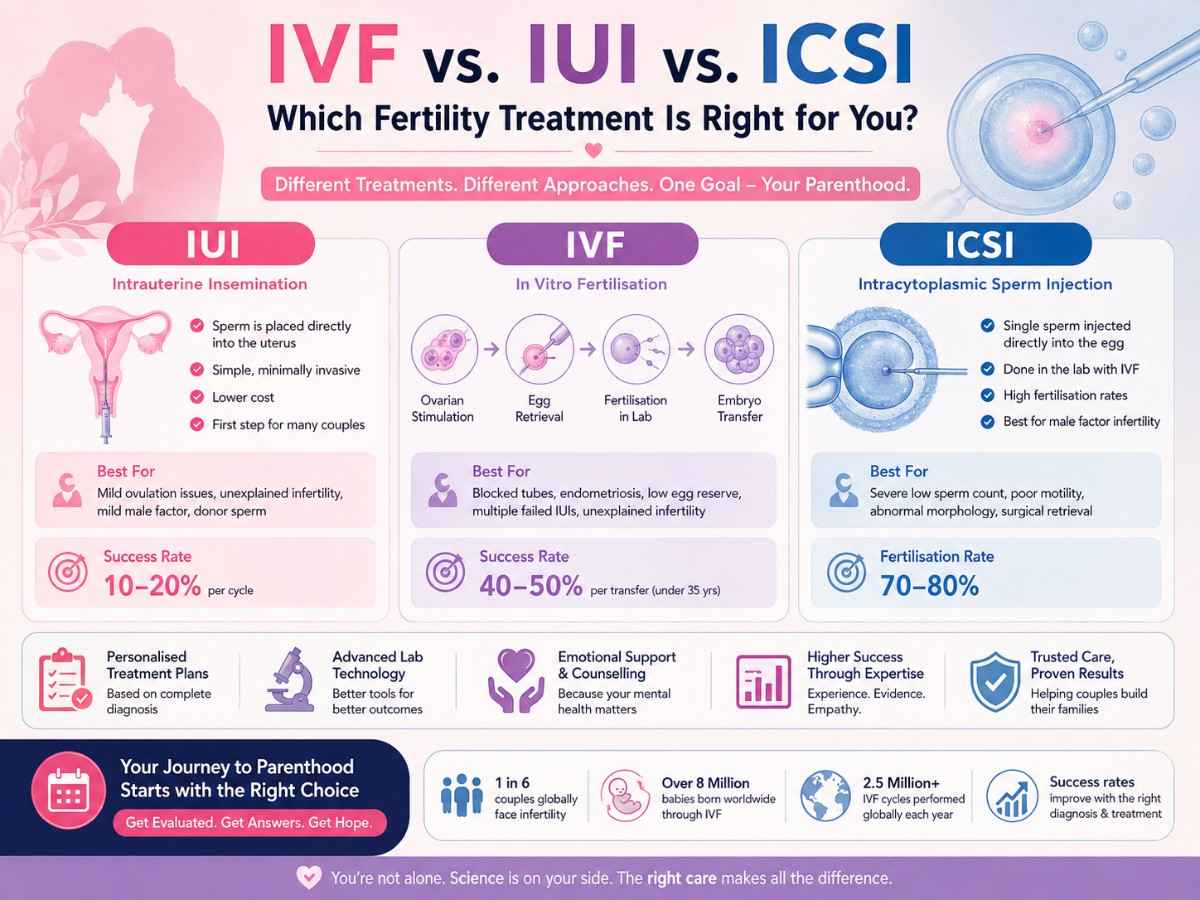
IUI stands for Intrauterine Insemination. Think of it as giving sperm a head start.
Basically, a doctor washes and concentrates the sperm sample. Then places it directly into the uterus during ovulation. The sperm doesn’t have to swim as far. The chances go up.
It’s simple. It’s minimally invasive. It’s often the first step.
So who’s a good fit for IUI?
- Couples with unexplained infertility
- Couples with unexplained infertility
- Men with mild low sperm count or motility issues
- Couples using donor sperm
- Cases where the cervical mucus is blocking sperm
Honestly, IUI success rates sit at around 10–20% per cycle. It’s lower than IVF. But it costs less, involves fewer injections, and feels much less intense. So doctors often try this first — especially if you’re under 35 and haven’t been trying for too long.
Not a good fit? If there’s severe male factor infertility, blocked tubes, or multiple failed IUI cycles — that’s when the conversation shifts.
What Is IVF — The One Everyone's Heard Of
IVF is In Vitro Fertilisation. The big one.
Here’s how it works, plain and simple:
- You take fertility medications to encourage your ovaries to produce multiple eggs
- You take fertility medications to encourage your ovaries to produce multiple eggs
- In a lab, the eggs meet the sperm and fertilise
- The resulting embryo (or embryos) gets transferred back into your uterus
- You wait. And hope
IVF success rates for women under 35? Around 40–50% per transfer. For women 35–40, it drops to 30–35%. After 40, it’s around 15–20% — though donor eggs can push that back up significantly.
Who needs IVF?
- Blocked or damaged fallopian tubes
- Severe endometriosis
- Ovarian dysfunction or low egg reserve
- Multiple failed IUI cycles
- Unexplained infertility that isn’t responding to other treatments
- Same-sex couples or single parents using donor eggs/sperm
So IVF isn’t the “last resort” it used to be. It’s actually the most reliable, best-studied fertility treatment available today. And for many couples in Noida and over India, it’s the treatment that finally worked.
💬 Want to Know Which Treatment Is Right for You? Book a consultation with Dr. Parul Agrawal — the best infertility specialist in Noida — and get a personalised plan based on your actual diagnosis. No guesswork. No generic advice. Just a clear path forward. 📞 Call Now | Book Your Appointment Today
What Is ICSI — And Why Is It a Game-Changer for Male Infertility?
ICSI stands for Intracytoplasmic Sperm Injection. It sounds intense. And honestly, it kind of is — in the most brilliant way.
Here’s what makes it different from regular IVF: instead of leaving the sperm and egg to fertilise on their own in a dish, an embryologist injects a single sperm directly into the egg using a microscopic needle.
One sperm. One egg. Direct injection. Fertilisation.
This is the go-to treatment for:
- Severe low sperm count (oligospermia)
- Poor sperm motility (asthenospermia)
- Abnormal sperm shape (teratospermia)
- Men who need surgical sperm retrieval (like TESA or PESA)
- Couples with previous IVF fertilisation failure
- Men with azoospermia (zero sperm in ejaculate — but sperm can sometimes be found surgically)
The best part? ICSI fertilisation rates are about 70–80%. That’s remarkably high. And it’s basically transformed male infertility treatment in the last two decades.
So if the problem is on the male side — this is often the answer. The best male infertility treatment in Noida is no longer “there’s nothing we can do.” It’s ICSI. And it works.
How Dr. Parul Agrawal Actually Decides What You Need
This is where it gets real.
Dr. Parul Agrawal doesn’t just hear “we’ve been trying for a year” and say “let’s do IVF.” She runs a full diagnostic workup before recommending anything. And that makes all the difference.
What the diagnostic process typically includes:
For women:
- Hormonal blood tests (AMH, FSH, LH, TSH, Prolactin)
- Transvaginal ultrasound for ovarian reserve
- HSG (Hysterosalpingography) to check tube patency
- Endometrial evaluation
For men:
- Detailed semen analysis
- Sperm DNA fragmentation test
- Hormonal profile
- Scrotal ultrasound if needed
So, only after understanding the full picture does Dr. Parul Agrawal suggest a treatment path. This is what separates a truly good IVF specialist in Noida from someone who just follows a standard checklist.
Her approach? Diagnose first. Treat second. Always explain why.
Real Couples, Real Results — What the Data Says
Let’s talk proof.
- A 2022 ICMART report showed that globally, over 2.5 million IVF cycles are performed per year — with more than 500,000 babies born annually
- In India, the fertility treatment market is growing at ~15% annually, with IVF centres reporting improved success rates due to better lab technology and individualised protocols
- ICSI has improved male factor infertility outcomes by over 60% compared to conventional IVF in cases of severe sperm issues
- Studies show that cumulative IVF success rates (accounting for multiple transfers from one egg retrieval) can reach 65–85% for women under 38
Also, couples who went through structured counselling and a personalised protocol showed higher success rates than those who followed generic treatment plans. Personalisation matters. It really does.
💬 Still Unsure Which Treatment Fits You? You don’t have to figure this out alone. Dr. Parul Agrawal’s clinic in Noida provides a complete fertility assessment that covers both partners — because infertility is rarely one person’s “problem.” 📅 Schedule Your Free Initial Consultation — Limited Slots Available
But Is IVF Painful? Will ICSI Hurt?" — Answering What You're Actually Afraid to Ask
IUI is basically painless. It feels like a Pap smear. A little cramping after, maybe. That’s about it
IVF involves injections. Daily self-injections for about 10–12 days. It sounds scary. Honestly, most women say it gets easier after the first two or three days. The egg retrieval is done under sedation — you won’t feel a thing during the procedure.
ICSI happens entirely in the lab. You don’t feel the injection into the egg. Your experience is identical to IVF.
The emotional part? That’s the harder side. The waiting. The hope. The uncertainty. That’s why having a doctor you trust — one who actually explains what’s happening and why — makes such a massive difference.
Also, at Dr. Parul Agrawal’s clinic, patients regularly mention that the team takes the time to explain everything. From the first consultation to the embryo transfer. That’s not something you find everywhere.
What Makes Dr. Parul Agrawal Different as an IVF Doctor in Noida
Straight up — there are many fertility clinics in Noida. So why does Dr. Parul Agrawal stand out?
First, she’s a specialist — not a general gynaecologist moonlighting in fertility. Infertility treatment is her primary focus.
Then comes the diagnostic depth. She insists on understanding why before deciding what. That means fewer wasted cycles, faster results, and better success rates.
Plus, her clinic uses updated lab protocols — including time-lapse embryo monitoring, hormonal priming, and endometrial receptivity assessment where needed.
Honestly, the thing patients talk about most isn’t even the clinical stuff — it’s how she listens. Infertility is emotionally exhausting. Having a doctor who doesn’t rush you, doesn’t dismiss your concerns, and actually answers your questions? That matters more than you’d expect.
So yes — as an IVF doctor in Noida, Dr. Parul Agrawal brings both technical expertise and human understanding to the table. And both matter.
The Emotional Side Nobody Talks About Enough
Let’s not skip this.
Fertility treatment is hard. Injections, appointments, two-week waits, negative tests. It wears on you. It wears on relationships. It’s okay to admit that.
Anyway, here’s what research shows: couples who receive emotional support alongside clinical treatment have better outcomes. Stress doesn’t directly cause infertility — but chronic stress can affect hormone levels and embryo implantation. Taking care of your mental health during this time isn’t optional. It’s part of the treatment.
Dr. Parul Agrawal’s approach includes counselling support and patient education — because informed, supported patients handle the process better and achieve better outcomes. Full stop
So — IVF, IUI, or ICSI: Which One Do YOU Need?
Here’s the simplified version:
Start with IUI if: You’re under 35, have been trying less than 2 years, no major diagnosis yet, mild male factor
Go straight to IVF if: You have blocked tubes, endometriosis, low egg reserve, or multiple failed IUIs
Choose ICSI (alongside IVF) if: The main issue is male factor — low count, poor motility, abnormal morphology, or need for surgical sperm retrieval
But honestly? Don’t try to self-diagnose this. The treatment you think you need might not be the one you actually need. Get tested. Get a diagnosis. Then decide.
That’s the Dr. Parul Agrawal approach. And it’s why she’s earned her reputation as the best infertility specialist in Noida not through marketing, but through results.
💬 Take the First Step Today Whether you’re just starting your fertility journey or you’ve been through failed cycles elsewhere, Dr. Parul Agrawal provides a fresh, thorough, compassionate evaluation. Your path to parenthood starts with one honest conversation. 📞 Book Your Consultation with Dr. Parul Agrawal — Noida’s Most Trusted Fertility Specialist
Wrapping Up — Because You Deserve Clarity
So here’s the real takeaway: IVF, IUI, and ICSI are not confusing once you understand the purpose of each. They’re tools. The right tool depends on your diagnosis
IUI is the gentle start. IVF is the powerful middle. ICSI is the targeted fix for male factor issues. And a great fertility specialist doesn’t push you toward the most expensive option — they find the right option.
At Dr. Parul Agrawal Fertility, that’s exactly what you get. A thorough workup. A personalised plan. A doctor who actually explains things. And a team that’s been helping couples in Noida — and over NCR — start their families for years.
The path forward exists. You just need the right guide.










Leave a Reply