
Blocked Fallopian Tubes: What Should You Discuss Before Choosing Treatment?
Blocked fallopian tubes keep the egg and sperm apart, but they rarely close the door on parenthood. Before choosing IUI, tubal surgery, or IVF, discuss where the block sits, whether the tubes hold fluid, your age, and your ovarian reserve.
Honestly, hearing “your tubes are blocked” feels like very hard to accept. You go for the consultation hoping for a plan, and suddenly you’re staring at an HSG report full of words you’ve never seen. Take a breath. Blocked tubes rank among the most common and most treatable reasons couples struggle to conceive. Plus, the right answer differs from one couple to the next. That’s why so many people all over Delhi NCR search for the Best IVF Doctor in Noida the moment the report lands. This guide will walks you through the questions worth asking before you commit to any treatment.
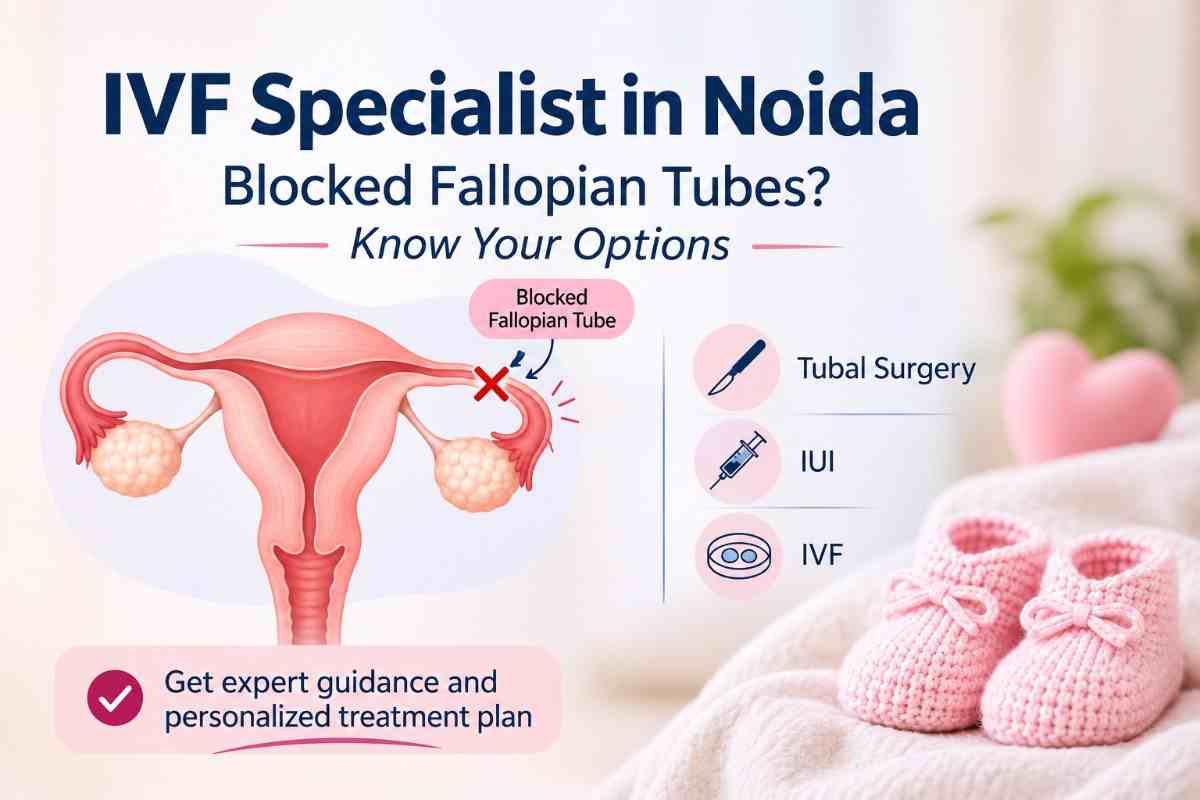
What do blocked fallopian tubes actually mean?
Each fallopian tube carries an egg from the ovary to the uterus and hosts fertilization. A blockage, whether partial or complete, stops sperm from reaching the egg or stops the embryo from travelling to the uterus. Where the block sits shapes your options.
Picture the tube as a narrow, flexible highway about 10 cm long. Tiny finger-like fimbriae at the far end sweep the egg in. Cilia inside the tube then push it along. Damage anywhere on that route can stall the whole journey.
Doctors describe blocks by location:
- Proximal block: The tube closes near the uterus. Sometimes it’s a true blockage, and sometimes it’s just temporary spasm or debris.
- Mid-tube block: Scarring pinches the tube somewhere in the middle.
- Distal block: The far end seals shut. Fluid often collects behind it, which creates a hydrosalpinx.
So how do you find out which one you have? Your doctor usually starts with a hysterosalpingography (HSG), an X-ray with dye, booked between days 7 and 10 of your cycle. A sonosalpingography (HyCoSy) gives similar information using ultrasound. When the picture stays unclear, a laparoscopy with a dye test lets the surgeon see the tubes directly. Alongside the tube check, a good workup includes AMH for ovarian reserve and a semen analysis for your partner. Honestly, skipping those two tests is the most common mistake couples make.
A Fertility Specialist in Noida who handles diagnostics and surgery under one roof can move through these steps in a few weeks instead of a few months. Dr. Parul Agrawal in Sector 92, runs consultation, imaging, laparoscopic and hysteroscopic surgery, and the IVF lab in the same building. Dr. Parul Agrawal have 23+ years of experience, including 10,000+ laparoscopic and hysteroscopic surgeries. Couples who want the Best Fertility Specialist in Noida for tubal factor usually look for exactly that combination.
How do your treatment options compare?
For blocked tubes, you generally choose between tubal surgery, IUI, and IVF. IUI only works when at least one tube is healthy and open. IVF bypasses the tubes completely, which makes it the most dependable route for different damage.
Here’s the thing: no single option wins for everyone. The table below shows how they stack up.
| Option | Best for | How it works | Typical timeline | Main limit |
| Hysteroscopic tubal cannulation | Proximal block near the uterus | A thin catheter clears the tube opening under camera guidance | Day-care procedure; try naturally for 6–12 months after | Won’t help scarring further along the tube |
| Laparoscopic tubal surgery | Mild adhesions, some distal blocks | The surgeon removes adhesions or reopens the tube end | Day-care or 1-night stay; try naturally for 6–12 months | Tubes may re-block; ectopic risk stays higher |
| IUI | One healthy, open tube plus normal sperm | Prepared sperm goes into the uterus around ovulation | 3–4 cycles are typically tried | Fails when both tubes are blocked |
| IVF / ICSI | Both tubes blocked, hydrosalpinx, older age, other factors | Eggs are retrieved, fertilized in the lab, and transferred to the uterus | About 10–14 days of stimulation, then a ~2-week wait after transfer | Higher cost and more medication |
| Salpingectomy, then IVF | Hydrosalpinx that affects implantation | The surgeon removes the damaged tube first, then you proceed to IVF | Surgery, brief recovery, then IVF | Permanent; the tube is gone |
Also, a quick note on timing. Tubal surgery only makes sense if you have time on your side. At 35 and above, waiting a year to see whether a repaired tube works can cost you precious eggs. Anyway, that’s a conversation your doctor should have with you openly, using your AMH and age as the guide. A Fertility Treatment Doctor in Noida who explains this plainly, instead of pushing one option, is worth trusting.
What causes blocked tubes, and which myths mislead couples?
Pelvic infection, endometriosis, genital tuberculosis, and previous surgery or ectopic pregnancy cause most tubal damage. Plenty of couples also believe myths, such as thinking every blocked HSG result is permanent or that one open tube guarantees success.
Let’s start with causes. Most come down to inflammation or scarring.
What are the 4 common causes?
- Pelvic inflammatory disease (PID): An old infection, sometimes silent, scars the tube lining. Chlamydia is a classic culprit.
- Endometriosis and adhesions: Tissue outside the uterus glues the tubes and ovaries to nearby organs.
- Genital tuberculosis: It’s a real concern in India, and it can damage tubes without obvious symptoms.
- Earlier surgery or an ectopic pregnancy: Appendix, fibroid, or ovarian cyst surgery can leave adhesions. A previous tubal pregnancy can scar the tube too.
Which myths cause the most confusion?
- “My HSG showed a block, so it’s permanent.” Not always. Spasm or a mucus plug can mimic a block on the day of the test. A repeat test or laparoscopy can clear things up.
- “One open tube means I’m fine.” Sometimes it does. But an open tube that works poorly, or one that carries fluid on the other side, still lowers your odds.
- “Blocked tubes mean I can’t conceive.” Wrong. IVF bypasses the tubes, and plenty of women with total blockage conceive.
- “Surgery is always better than IVF.” Surgery suits a narrow group. For many couples, IVF gets there faster with fewer unknowns.
Honestly, a fertility treatment doctor in noida should walk you through your own HSG images instead of just reading you the verdict.
How do you decide between surgery, IUI, and IVF?
Your decision hinges on four things: how many tubes are blocked, whether a hydrosalpinx exists, your age and AMH, and your partner’s semen analysis. Your doctor should weigh all four together before recommending a path.
So how does this look in practice? Most good clinics follow a simple sequence:
- Confirm the block. Repeat or upgrade the HSG with HyCoSy or laparoscopy when the result looks doubtful.
- Check ovarian reserve. Run an AMH and an antral follicle count on ultrasound.
- Check the male factor. Order a semen analysis before anyone books a procedure.
- Look for hydrosalpinx. Fluid-filled tubes can lower implantation rates, so many doctors remove or clip them before IVF.
- Match the plan to your timeline. Age and reserve decide how long you can afford to wait.
Here’s a rule of thumb that holds up in practice: IVF success generally declines gradually after age 35, so the clock matters more than most couples expect. Doctors usually try 3–4 IUI cycles before moving to IVF, but that only applies when your tubes allow it. With both tubes blocked, IUI has nothing to work with, so IVF becomes the straightforward choice.
Plus, ask about the ectopic risk. Damaged tubes raise the chance that an embryo implants in the tube instead of the uterus. Early scans after any positive test keep you safe. A Fertility Specialist in Noida who monitors your early pregnancy closely makes a real difference here.
What should you ask before choosing a fertility specialist?
Ask about experience with tubal factor cases, whether diagnostics, surgery, and the IVF lab sit under one roof, how the doctor personalizes protocols, and how clearly the team explains costs and success expectations. Good answers sound specific, not rehearsed.
Here’s the thing: The Best IVF Doctor in Noida for your friend may not suit you. Use this checklist in your consultation:
- “How many tubal cases do you treat each year?” Look for hands-on numbers, not vague claims. For context, Dr. Parul Agrawal has performed 12,000+ IVF cycles, 19,000+ IUI treatments, and 10,000+ laparoscopic and hysteroscopic surgeries.
- “Can you handle diagnostics, surgery, and IVF in one place?” Fewer handoffs mean fewer delays. At Dr. Parul Agrawal Fertility in Sector 92, your consultation, imaging, surgery, and IVF lab all sit under one roof.
- “Will you review my HSG images with me?” You deserve to see what the doctor sees.
- “Do you recommend removing a hydrosalpinx before IVF?” A confident answer shows current thinking.
- “How do you personalize the stimulation protocol?” Your AMH, age, and history should drive it, not a template.
- “What does the full plan cost, and what could change it?” Honest clinics explain the range upfront.
- “What happens if this cycle doesn’t work?” A good team has a plan B ready before plan A starts.
The bottom line is simple: you want a doctor who explains, listens, and tells you the truth even when the truth is “IVF is your best route.” Plenty of couples shortlist the Best Fertility Specialist in Noida based on exactly these answers, not on advertising.
FAQ: What do couples ask most about blocked tubes?
Couples mostly ask whether they can conceive naturally, whether surgery beats IVF, how long treatment takes, and how to pick the right doctor. The answers below stay short and factual so you can scan them quickly.
If both tubes are completely blocked, natural conception is very unlikely. With a partial block or one healthy open tube, pregnancy remains possible. Your doctor confirms the status with an HSG, Hysteroscopy or laparoscopy, and then recommends surgery, IUI, or IVF based on your age and AMH.
It depends on your situation. Tubal surgery suits mild adhesions or a limited proximal block in younger women. IVF suits both-tube blockage, hydrosalpinx, age above 35, or additional male-factor issues. IVF bypasses the tubes, so it doesn’t depend on repair.
Diagnostics usually take 2–4 weeks. An IVF cycle runs about 10–14 days of stimulation, then egg retrieval, embryo transfer, and a ~2-week wait for the pregnancy test. Tubal surgery needs a short recovery, followed by 6–12 months of trying naturally when age allows.
Look for a Best IVF Doctor in Noida who offers diagnostics, surgery, and an in-house IVF lab, explains your options without pressure, and shares realistic expectations. Ask to review your reports together. Dr. Parul Agrawal Fertility in Sector 92 offers all of these under one roof.








Leave a Reply