
At What Age Should You Really Worry About Fertility? Doctors Reveal the Truth
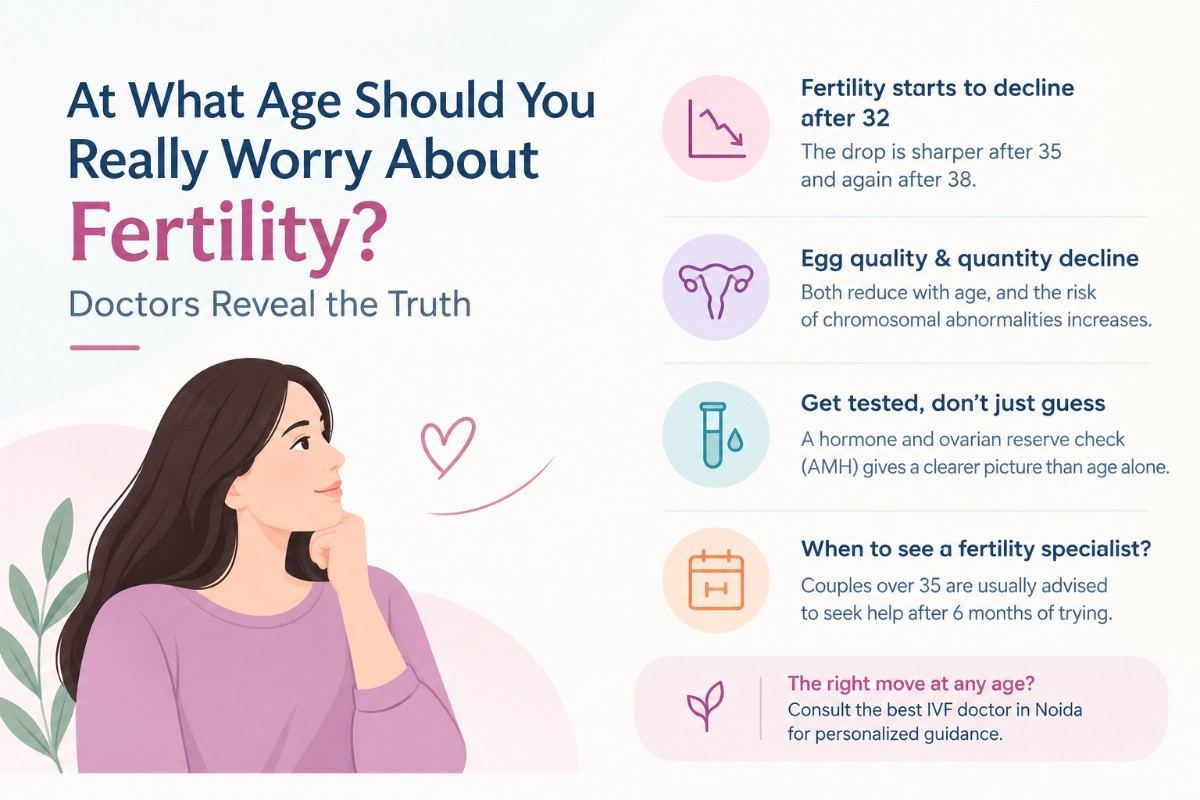
Fertility start’s at a decline age after 32, with a sharper drop after 35 and again after 38 — but “worry” isn’t the right word. The right move at any age is a simple hormone and ovarian reserve check with a Best IVF Doctor in Noida before trying on your own for too long.
Honestly, this question comes up in almost every first consultation. “Doctor, am I too late?” Here’s the thing — there’s no single magic number where fertility falls off a cliff. It’s a slope, not a wall. But the slope does get steeper at certain points, and knowing where you stand on it changes what you should do next.
So, What Actually Happens to Fertility With Age?
Egg quantity and quality both decline majorly from your early 30s, dropping more noticeably after 35 and again past 38. Male fertility declines too, just more slowly — which is why couples over 35 are usually advised to see a Fertility Specialist in Noida after just six months of trying without having any protection used, not a full year even.
A woman is born with all the eggs she’ll ever have — roughly one to two million at birth, down to a few hundred thousand by puberty. Each month, that pool shrinks a little further. So, by your early 30s, both the number and the genetic quality of your remaining eggs are quietly declining. Plus, the eggs that remain are more likely to carry chromosomal abnormalities, which is part of why miscarriage rates goes high with age too.
This is also usually the first thing any experienced Fertility Specialist in Noida will ask about in an initial consult — not your age on paper, but your actual hormone numbers also.
Here’s what the numbers roughly look like:
- Under 30: Natural conception chance per cycle is around 20–25%
- 30–34: Still fairly good, though it starts tapering
- 35–37: A noticeably steeper decline begins
- 38–40: Decline accelerates further
- 40+: Natural conception becomes considerably harder, and donor-egg conversations often start here
Also, don’t forget AMH (Anti-Müllerian Hormone) — it’s the blood test that estimates ovarian reserve. A low AMH at 32 can mean more urgency than a “normal” AMH at 37. So age alone never tells the whole story; the test does.
Age-Wise Fertility Snapshot: What Changes and When
| Age Range | Egg Quantity | Egg Quality | Natural Conception Odds/Cycle | Typical Recommendation |
| Under 30 | High | Good | ~20–25% | Try naturally; see a doctor after 12 months |
| 30–34 | Moderate-high | Good, slight decline | ~15–20% | Try naturally; evaluate after 12 months |
| 35–37 | Declining | Declining | ~10–15% | See a doctor after 6 months |
| 38–40 | Low-moderate | Notably declining | ~5–10% | See a doctor promptly; consider IVF sooner |
| 40+ | Low | Significantly declining | Below 5% | Consult promptly; donor-egg discussion may apply |
So, if you’re 36 and it’s been six months you are trying without any success, that’s not a red flag — it’s just the point where seeing a doctor makes more sense than waiting it out. A quick consultation with a Best IVF Doctor in Noida at this stage usually gives more clarity than another few months of guessing.
IUI or IVF — How Do You Know Which One You Need?
IUI is usually tried first for mild, unexplained, or male-factor infertility in women under 35 — typically for 3–4 cycles. IVF becomes the better route with blocked tubes, low ovarian reserve, higher maternal age, or after IUI hasn’t worked, and a Best IVF Specialist Doctor in Noida can usually tell within one detailed consultation which path fits you.
| Factor | IUI | IVF |
| Best suited for | Mild male factor, unexplained infertility, ovulation issues | Blocked tubes, severe male factor, low reserve, failed IUI |
| Typical age cutoff | Usually under 35 | Any age, especially 35+ |
| Success rate per cycle | ~10–15% | ~35–45% (varies by age) |
| Process | Sperm washed, placed directly in the uterus | Eggs retrieved, fertilized in lab, embryo transferred |
| Cycles usually tried | 3–4 before moving on | 1–3 depending on response |
| Approx. timeline | A few days around ovulation | 10–14 day stimulation + retrieval + transfer |
How Many IUI Cycles Before IVF Makes Sense?
Generally, 3 to 4 IUI cycles is the point where most fertility specialists suggest reconsidering the approach. Anyway, if you’re over 35, some doctors shorten that window to 2–3 cycles simply because time matters more at that age. There’s genuinely no shame in moving faster — it isn’t “giving up,” it’s being strategic and save your time for the accurate treatment.
That said, a Best IVF Treatment Doctor in Noida will usually customize this timeline based on your specific test results rather than applying a common rule to every patient. This is the kind of individualized read a Best IVF Specialist Doctor in Noida is trained to give, rather than a one-size-fits-all number.
What’s the IVF Journey Actually Like?
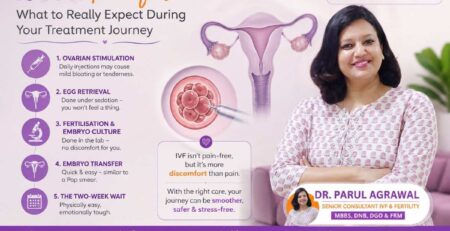
A typical IVF cycle involves 10–14 days of ovarian stimulation with hormone injections, egg retrieval under light sedation, fertilization in the lab (IVF or ICSI), embryo culture for 3–5 days, and either a fresh or frozen embryo transfer — followed by the well-known two-week wait for a pregnancy test.
Most patients researching a Best IVF Doctor in Noida want to know exactly what they’re signing up for before the first injection — so here’s the full picture:
- Baseline testing — AMH, HSG (to check the fallopian tubes), semen analysis for the partner, thyroid and prolactin levels
- Ovarian stimulation — daily injections for 10–14 days to encourage multiple eggs to mature stage.
- Trigger shot and retrieval — a quick, sedated procedure to collect the eggs
- Fertilization — via conventional IVF or ICSI (a single sperm injected into each egg), depending on sperm quality
- Embryo culture — embryos are monitored for 3–5 days
- Transfer — the healthiest embryo(s) placed back in the uterus
- The two-week wait — followed by a blood pregnancy test
So yes, it’s a process. But most patients say the anticipation is harder than the procedures themselves. Patients often say choosing the Best IVF Specialist Doctor in Noida made the biggest difference in how smoothly this process went, more than any single step along the way.
The Biggest Misconceptions That Keep Couples Waiting Too Long
Honestly, most delays in fertility treatment come down to myths, not medical facts. Here are the ones we hear most often:
- “We’re young, so there’s no rush.” Age matters for both partners, but especially for egg quality — waiting an extra two or three years at 33 can matter more than people expect.
- “IVF always works on the first try.” It doesn’t, and that’s normal. Success often takes 1–3 cycles, and a good clinic will tell you this upfront rather than overpromising to you, for giving false hope.
- “Infertility is almost always the woman’s issue.” Not true — male factor accounts for roughly a third of cases, which is why semen analysis is one of the very first tests done.
- “You should try naturally for a full year no matter your age.” Not after 35. Six months of trying without success is enough reason to get checked.
A good Best IVF Specialist Doctor in Noida will walk you through realistic odds rather than letting these myths quietly guide your timeline.
Your Checklist Before Choosing a Fertility Specialist
Plus, picking the right clinic matters just as much as picking the right time. Before your first consultation, it helps to ask:
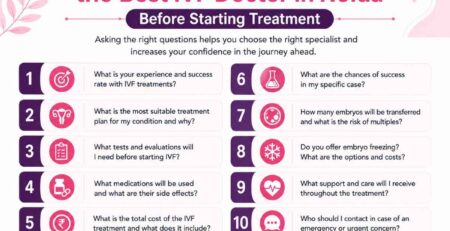
- What’s the clinic’s live birth rate, not just pregnancy rate, broken down by age group?
- Are diagnostics, consultation, and the IVF lab all under one roof, or will you be shuttled between locations for tests?
- How many IVF cycles and IUI treatments has the doctor personally overseen?
- What’s the protocol for your specific case — a standard plan, or one personalized to your AMH, age, and history?
- How transparent is the cost breakdown, including medication costs that can vary cycle to cycle?
This is exactly why couples in the region often search for the Best IVF Doctor in Noida rather than picking the nearest clinic — the difference in lab quality and doctor experience genuinely affects outcomes. Any Best IVF Treatment Doctor in Noida worth choosing should be able to answer all of these questions clearly, without vague reassurances.
At Dr. Parul Agrawal Fertility in Sector 92, Noida, consultation, diagnostics, laparoscopic and hysteroscopic procedures, and the IVF lab all sit under one roof, which cuts down on the back-and-forth that adds stress to an already anxious process. With 23+ years of clinical experience and thousands of IVF cycles, IUI treatments, and laparoscopic/hysteroscopic surgeries performed, Dr. Parul Agrawal has seen just about every version of this journey — and it’s exactly the kind of hands-on track record that has earned her the reputation of a Best IVF Doctor in Noida over more than two decades of practice.
When Should You Actually See a Doctor?
- Under 35: After 12 months of trying without success
- 35 and older: After 6 months
- 38 and older: Ideally right away, or after just 3–4 months
- Any age, with known issues (PCOS, endometriosis, irregular cycles, previous miscarriages, low sperm count): Don’t wait — consult sooner
So, if any of these apply to you, that’s your answer. Reaching out to a Fertility Specialist in Noida at this stage costs you nothing but honestly saves you months, sometimes years.
Frequently Asked Questions
Q1: At what age does female fertility start declining significantly?
Fertility begins a gradual decline in the early 30s, with a more noticeable drop after 35 and a sharper one after 38. This isn’t a hard cutoff — it varies by individual ovarian reserve, which is why an early consultation with a Best IVF Doctor in Noida can clarify where you actually stand, rather than guessing based on age alone.
Q2: How do I find the Best IVF Specialist Doctor in Noida for my situation?
Look for a doctor with extensive hands-on experience over IVF, IUI, and reproductive surgery, ideally with diagnostics and the lab on-site. Ask about age-specific success rates and how customize the treatment protocol is, rather than depending on generic reviews alone.
Q3: Is IUI a waste of time if I’m already 36?
Not necessarily, but the window is shorter. Most specialists suggest limiting IUI to 2–3 cycles at this age before moving to IVF, since time has more impact on outcomes past 35. A Best IVF Treatment Doctor in Noida can review your specific case and tell you honestly whether IUI is still worth trying.
Q4: What makes someone the Best IVF Treatment Doctor in Noida rather than just an average one?
Experience volume matters — years in practice, number of cycles performed, and success rates by age group. So does having consultation, diagnostics, and the IVF lab in one facility, since that reduces delays and miscommunication between different providers handling your case. Ask any Best IVF Treatment Doctor in Noida directly about these numbers during your first visit — a confident, specific answer is a good sign.
Conclusion
There’s no single age where you should suddenly “worry.” What matters is knowing your own numbers — AMH, cycle history, and any underlying conditions — and acting on them rather than the calendar alone. Whether you’re 29 and just curious or 38 and feeling the clock, a conversation with a doctor costs you nothing but a bit of time, and it might save you a lot more of it later.
If you’ve been trying for six months past 35, or a year under 35, that’s genuinely reason enough to get checked. Ultimately, the Best IVF Specialist Doctor in Noida for you is the one whose success rates, transparency, and bedside manner all line up with what you need — not just the one with the flashiest ads. Dr. Parul Agrawal Fertility’s Sector 92 clinic has built its reputation on exactly that kind of straight-talking, all-under-one-roof care, backed by 23+ years of hands-on IVF, IUI, and surgical experience.









Leave a Reply