

How to Evaluate an IVF Clinic: 7 Important Factors to Consider Before Treatment
The right fertility specialist explains your diagnosis, matches the treatment according to your age and test results, and shows you their lab before you commit for any treatment. Use this guide to judge any Fertility Clinic in Noida on experience, diagnostics, clarity, and support.
So here’s the thing: your choice of Fertility Specialist in Noida shapes your journey more than almost any other important decision. A wrong turn can costs you months, money, and energy you can’t get back. Let’s help you choose the best ivf doctor in Noida.
What Actually Happens in an IVF Cycle, and Why Does Your Doctor Matter So Much?
An IVF cycle runs about four to six weeks: ovarian stimulation for 10–14 days, egg retrieval, fertilization in the lab, embryo transfer, and a two-week wait. Your doctor’s decisions at each step, especially protocol choice, directly influence how your cycle performs.
Here’s the process, step by step:
- Baseline testing: Your doctor checks AMH (ovarian reserve), an antral follicle count by ultrasound, day 2–3 FSH and estradiol, and your partner’s semen analysis. An HSG or hysteroscopy checks your tubes and uterine cavity.
- Ovarian stimulation (10–14 days): You take daily hormone injections while ultrasounds track follicle growth every two to three days. Common approaches include the antagonist protocol, the long agonist protocol, and mild stimulation.
- Trigger and egg retrieval: A trigger injection matures the eggs. About 36 hours later, the doctor retrieves them in a 15–20 minute procedure under sedation.
- Fertilization and culture: Embryologists fertilize the eggs by conventional IVF or ICSI, then grow the embryos for three to five days, often to the blastocyst stage.
- Embryo transfer: The doctor transfers a fresh embryo or freezes embryos (vitrification) for a later frozen transfer.
- The two-week wait: A beta-hCG blood test, roughly 10–14 days after transfer, confirms pregnancy.
Each step involves judgment calls. Honestly, that’s why the Best IVF Doctor in Noida never runs the same protocol on every patient. A 28-year-old with PCOS needs a different plan than a 38-year-old with low AMH. PCOS raises the risk of ovarian hyperstimulation syndrome (OHSS), so a skilled doctor lowers doses or freezes all embryos. Low ovarian reserve calls for a different stimulation strategy altogether.
Dr. Parul Agrawal Fertility in Sector 92 works this way. Dr. Parul Agrawal brings 23+ years of experience, thousands of IVF cycles, thousands of IUI treatments, and thousands of laparoscopic and hysteroscopic surgeries. Consultation, diagnostics, surgery, and the IVF lab all sit under one roof, which is exactly what a strong Fertility Clinic in Noida should offer. Nothing gets lost between departments, and one team knows your whole story.
How Do IUI and IVF Compare, and Which One Fits You?
IUI places prepared sperm inside the uterus around ovulation and suits milder fertility issues. IVF fertilizes eggs in the lab and suits blocked tubes, severe male factor, older age, or failed IUIs. Most doctors try three to four IUI cycles first.
Any Fertility Clinic in Noida should walk you through this comparison on day one. Here it is:
| Factor | IUI | IVF |
| Where fertilization happens | Inside your body | In the embryology lab |
| Medication | Oral tablets or low-dose injections | Daily injections for 10–14 days |
| Cycle length | About two weeks | Four to six weeks |
| Procedure | Quick insemination, no anesthesia | Egg retrieval under sedation, then embryo transfer |
| Best for | Unexplained infertility, mild male factor, ovulation problems | Blocked tubes, endometriosis, severe male factor, low ovarian reserve, repeated IUI failure |
| Typical attempts | 3–4 cycles | 1–3 cycles |
| Success per cycle | Lower | Higher, and depends heavily on age |
| Cost | Lower | Higher |
How Many IUI Cycles Before IVF Makes Sense?
Doctors typically try three to four IUI cycles before recommending IVF, if your tubes are open and your partner’s semen parameters are adequate. Age changes this. Women over 35 often move to IVF sooner because time matters more.
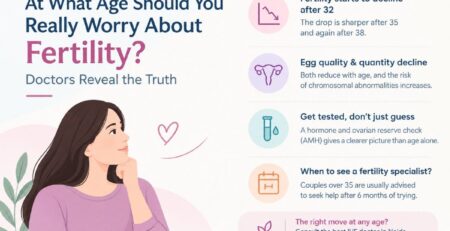
IVF success generally declines gradually after 35 and more steeply after 40, because egg quantity and quality both fall. So the Best IVF Doctor in Noida won’t keep you on IUI for a year when your numbers say otherwise. Plus, blocked tubes, severe male factor, or advanced endometriosis usually skip IUI entirely.
Where Do Couples Go Wrong When Choosing an IVF Doctor?
Couples most often choose by advertising or price, assume everyone needs IVF, skip the male workup, or ignore uterine problems. Avoiding these four mistakes protects your time, money, and emotional energy before your first cycle even starts.
- Mistake 1: Picking the loudest ad. Billboards don’t make embryos. Success comes from accurate diagnosis, the right protocol, and lab quality. The Best IVF Doctor in Noida earns trust by explaining, not by advertising.
- Mistake 2: Assuming everyone needs IVF. Some women need only ovulation induction or a hysteroscopic polyp removal. The Best Fertility Treatment Doctor in Noida recommends the least invasive option that works.
- Mistake 3: Skipping the male workup. Male factors contribute to roughly 40–50% of infertility cases. A semen analysis costs little and takes a day. Anyway, no cycle should start without one.
- Mistake 4: Ignoring the uterus and tubes. Fibroids, polyps, a uterine septum, or a fluid-filled tube (hydrosalpinx) can lower implantation odds. Hysteroscopy and laparoscopy correct these. A specialist who performs both surgery and IVF sees your full picture.
What Should You Ask Before Choosing the Best Fertility Treatment Doctor in Noida?
Ask about experience, personalized protocols, diagnostics, in-house lab access, surgical capability, age-wise success reporting, transparent costs, and failure planning. Clear, specific answers signal a trustworthy Fertility Specialist in Noida; vague answers signal trouble.
Save this list on your phone and bring it to every consultation:
- “How many IVF cycles have you performed, and for how many years?” Look for long, consistent experience, not just a new brand.
- “How do you choose my protocol?” Your age, AMH, antral follicle count, and history should drive the answer.
- “Which tests will you run before recommending IVF?” Expect AMH, ultrasound, semen analysis, HSG or hysteroscopy, and thyroid and prolactin checks.
- “Is your embryology lab in-house? Can I see it?” Ask about blastocyst culture, vitrification, and embryologist experience.
- “Can you treat fibroids, polyps, or endometriosis yourself?” In-house laparoscopy and hysteroscopy save weeks.
- “How do you report success rates?” Ask for figures by age group and per embryo transfer. Walk away from guarantees.
- “What does the quoted cost include?” Medications, monitoring scans, freezing, and transfer should appear on one clear estimate.
- “Who can I call when I’m worried at 9 pm?” Support matters during injections and the two-week wait.
- “What happens if this cycle fails?” A good doctor reviews the cycle with you and adjusts the plan.
Any Fertility Clinic in Noida worth your trust will welcome every one of these questions. Honestly, a defensive doctor tells you plenty. The Best Fertility Treatment Doctor in Noida makes you feel informed, not rushed.
What Are the Most Common Questions Patients Ask?
Here are four questions patients ask most before booking a first consultation, answered directly. Each answer stands alone, so you can scan quickly and get the facts you need without reading everything above.
Who Is the Best IVF Doctor in Noida for a First-Time IVF Patient?
No single name fits every couple, so judge on evidence. Look for deep experience, personalized protocols, a full diagnostic workup, and an in-house lab. Dr. Parul Agrawal Fertility in Sector 92 offers 23+ years of experience and thousands of IVF cycles. Still, the Best Fertility Treatment Doctor in Noida for you is the one who answers your questions clearly and earns your trust.
How Much Does Age Affect IVF Success?
Age is the biggest single factor. Egg quantity and quality decline gradually after 35 and more steeply after 40, so success per cycle falls with age. That said, AMH, uterine health, and sperm quality also matter. Your doctor should give you an age-specific estimate, not a generic promise.
Do Both Partners Need to Visit a Fertility Clinic in Noida?
Yes, ideally together. Male factors contribute to roughly 40–50% of infertility cases, so the first visit should include a semen analysis alongside your AMH, ultrasound, and possibly an HSG. One joint visit saves weeks of guesswork.
When Should I See a Fertility Specialist in Noida?
If you’re under 35, see a specialist after 12 months of trying. If you’re 35 or older, go after six months. Over 40, go right away. Also book sooner if you have irregular periods, endometriosis, known tubal problems, or a history of pelvic surgery.
What’s the Bottom Line on Choosing an IVF Doctor?
Choose a doctor who diagnoses thoroughly, personalizes treatment, works with an in-house lab and surgical team, and speaks plainly about odds and costs. Trust evidence and how you feel in the room, not advertising.
Conclusion
The Best IVF Doctor in Noida listens first, tests thoroughly, and tells you the truth about your odds. The Best Fertility Treatment Doctor in Noida treats you as a person, not a cycle number. And any Fertility Clinic in Noida worth choosing keeps diagnostics, surgery, and the lab close together.










Leave a Reply