
Dr. Parul Agrawal Explains: PCOS Fertility Treatment Options in 2026
Quick answer: PCOS is one of the most treatable causes of infertility — most women with PCOS do eventually conceive, often without IVF. Treatment usually starts with lifestyle and ovulation-inducing medication, moves to IUI if needed, and reaches IVF only when simpler options haven’t worked. The right path depends on your age, AMH levels, partner’s semen analysis, and how your body responds to early treatment.
If you’ve just been told you have PCOS and you’re trying to get pregnant, take a breath. Honestly, this is one of the more manageable reasons for a delayed pregnancy — not because it’s simple, but because we understand it well and have a whole ladder of options before anyone even mentions the word “IVF.” A lot of women searching for the best fertility clinic in Noida land here right after this exact diagnosis, so you’re in good company.
I’m Dr. Parul Agrawal, and I’ve spent over 23 years treating women with PCOS at my clinic in Sector 92, Noida — often described by patients as the best fertility clinic in Noida for exactly this kind of complex, hormone-driven case. I’ve walked thousands of patients through this exact conversation, and I’ve seen the same fear on almost every face — “does this mean I can’t have kids?” No. It usually just means your path looks a little different. Let’s talk through what that path actually looks like in 2026.
What Is PCOS Actually Doing to Your Fertility?
Direct answer: PCOS disrupts ovulation by throwing off the hormonal signals your ovaries need to release an egg regularly. No egg release means no natural chance of pregnancy that cycle — but the eggs themselves are usually fine, which is genuinely good news.
Here’s the thing people get wrong about PCOS — they think it means “bad eggs” or “damaged ovaries.” That’s not quite it. Polycystic Ovary Syndrome is fundamentally a hormonal imbalance. Your body produces excess androgens (male hormones like testosterone), and this throws off the delicate feedback loop between your brain and ovaries that’s supposed to trigger monthly ovulation.
So instead of one dominant follicle maturing and releasing an egg each month, you get multiple small, underdeveloped follicles that stall out — those are the “cysts” people talk about, though they’re not cysts in the traditional sense at all.
Also, insulin resistance plays a huge role here. Plus, it’s genuinely a spectrum — some women with PCOS ovulate irregularly every 45–60 days, others barely ovulate at all without help. Your specific hormonal picture determines your treatment plan, not a generic PCOS label.
When you come in for a consultation, we typically run:
- AMH (Anti-Müllerian Hormone) — to assess ovarian reserve, which tends to look higher-than-average in PCOS
- Fasting insulin and glucose — to check for insulin resistance
- LH/FSH ratio — often elevated in PCOS
- Pelvic ultrasound — to visualize follicle count and ovarian volume
- Partner’s semen analysis — because fertility is a two-person equation, always
At Dr. Parul Agrawal Fertility, all of this diagnostic work happens in-house in Sector 92 — no running between labs and clinics across Noida while you’re already anxious. Consultation, diagnostics, and treatment planning all happen under one roof, which is one reason people consistently rank us among the best fertility clinic in Noida options when they’re comparing where to start.
The Treatment Ladder: What Actually Happens, Step by Step
Direct answer: Most PCOS patients start with weight and lifestyle management plus ovulation-inducing pills, move to injectable gonadotropins or IUI if pills alone don’t work after a few cycles, and consider IVF only after multiple failed IUI attempts or additional complicating factors.
Let’s be clear about something — nobody should jump straight to IVF for PCOS unless there’s a specific reason to (like a blocked fallopian tube, severe male-factor infertility, or age-related urgency). The vast majority of PCOS patients respond beautifully to simpler treatment first.
Step 1: Lifestyle and Metabolic Correction (Weeks 1–12)
Even a 5–10% reduction in body weight can restart natural ovulation in many PCOS patients. This isn’t about aesthetics — it’s about improving insulin sensitivity, which directly calms down that androgen excess we talked about earlier. We often pair this with metformin if insulin resistance is significant.
Step 2: Ovulation Induction with Oral Medication (Cycles 1–6)
This is usually where treatment actually begins in earnest. Letrozole is now the first-line medication for PCOS-related ovulation induction — it’s replaced Clomiphene Citrate as the preferred option for most patients because studies have shown better ovulation and live birth rates, particularly in women with PCOS. We monitor follicle growth via ultrasound and time intercourse or IUI around the fertile window.
Step 3: Intrauterine Insemination, or IUI (If pills alone aren’t leading to pregnancy)
If you’re ovulating on medication but not conceiving after a few tries, IUI adds precision. We wash and concentrate the partner’s (or donor’s) sperm and place it directly into the uterus around ovulation, timed with either a natural or medicated cycle. Typically, 3–4 IUI cycles are tried before we seriously discuss moving to IVF — though this number shifts based on your age and how each cycle responds.
Step 4: Injectable Gonadotropins (For patients not responding to oral medication)
Some PCOS patients don’t respond adequately to Letrozole or Clomiphene alone. In these cases, we step up to injectable FSH/LH medications under close monitoring — PCOS ovaries can be quite sensitive to stimulation, so this stage requires careful dose titration to avoid overstimulation (OHSS).
Step 5: IVF or IVF with ICSI (When simpler options haven’t worked, or other factors are involved)
This is the stage where choosing the best IVF doctor in Noida for your specific case really starts to matter, since PCOS stimulation protocols require experienced, careful dose management.
IVF becomes the recommended path when IUI cycles haven’t succeeded, when there’s an additional fertility factor (blocked tubes, significant male-factor infertility, age above 35), or when time is genuinely limited. A typical antagonist protocol for PCOS involves roughly a 10–14 day ovarian stimulation phase, egg retrieval, fertilization (with ICSI if sperm parameters are borderline), and either a fresh or frozen embryo transfer. Because PCOS ovaries respond so strongly to stimulation, many specialists — myself included — often recommend a freeze-all approach, transferring the embryo in a later frozen cycle to reduce OHSS risk and improve implantation conditions.
IUI vs. IVF for PCOS: A Side-by-Side Look
Patients ask me this constantly, so here’s the comparison in one place.
| Factor | IUI | IVF (with/without ICSI) |
|---|---|---|
| Best for | Ovulatory issues, mild male-factor, unexplained infertility | Failed IUI cycles, tubal blockage, significant male-factor, age 35+ |
| Process complexity | Low — timed insemination, minimal monitoring | High — stimulation, egg retrieval, lab fertilization, embryo transfer |
| Typical cycles before reassessment | 3–4 cycles | Often achieves pregnancy in fewer cycles, but higher cost/cycle |
| OHSS risk in PCOS patients | Low to moderate with careful dosing | Higher without a freeze-all strategy — needs close monitoring |
| Approx. timeline per cycle | 2–3 weeks | 4–6 weeks including the stimulation phase and transfer |
| Cost per cycle | Lower | Higher |
Neither option is “better” in the abstract — it genuinely depends on your specific hormonal profile, age, and what’s already been tried. That’s why we build the plan around you, not around a generic protocol. This individualized approach is honestly what most patients are hoping to find when they start searching for the best fertility specialist in Noida — someone who reads your numbers, not just a standard checklist.
Also, this is usually the point where patients start comparing clinics more seriously — and if you’re doing that research yourself, it’s worth reading how each best IVF doctor in Noida candidate explains OHSS risk before you commit to a stimulation plan.
Common Misconceptions (and What’s Actually Going On)
“PCOS means I need IVF no matter what.” Not true at all. Most PCOS patients conceive through lifestyle changes, oral ovulation induction, or IUI. IVF is reserved for when those steps haven’t worked or aren’t appropriate for your situation.
“If I’m ovulating irregularly, I’m not ovulating at all.” Irregular isn’t the same as absent. Plenty of women with PCOS ovulate on their own timeline — it’s just less predictable, which is exactly why cycle tracking and follicle monitoring matter so much.
“Losing weight will fix everything.” Weight management genuinely helps a large portion of patients, but it’s not a universal fix. Some women with PCOS are lean and still have significant hormonal imbalance — insulin resistance and androgen excess don’t only show up in higher body weights.
“Once I start fertility treatment, I’m locked into IVF eventually.” Also not true. Treatment is a ladder, not a one-way street. Many patients get pregnant at Step 2 or Step 3 and never touch an IVF lab.
Your Checklist Before Choosing a Fertility Specialist
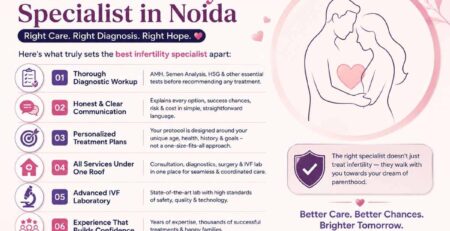
Whether you’re weighing a specific name or just typing “best fertility specialist in Noida” into a search bar at midnight — which, honestly, most of us do at some point during this process — the same five checks apply.
Picking the right doctor matters just as much as picking the right protocol. Before your first consultation, it helps to know what you’re actually evaluating:
- Do they run in-house diagnostics, or will you be sent to three different labs across the city for AMH, ultrasound, and semen analysis?
- Do they explain the full treatment ladder, or push straight toward IVF regardless of your specific case?
- How experienced is the specialist with PCOS-specific protocols, including OHSS risk management for injectable stimulation?
- Is there continuity of care — same doctor from diagnosis through surgery (if needed) through the IVF lab, or do you get passed between departments?
- Do they give you honest, general ranges rather than guaranteed outcomes or inflated success numbers?
Anyway, this is exactly the kind of thing to ask directly in your first consultation. A good fertility specialist in Noida won’t be offended by these questions — they’ll expect them. Honestly, if a doctor seems irritated by a checklist like this, that itself is useful information.
At Dr. Parul Agrawal Fertility, we built the clinic around exactly this continuity — consultation, diagnostics, laparoscopic or hysteroscopic surgery if it’s needed, and the IVF lab itself all sit under one roof in Sector 92, Noida. You’re not being shuffled between five different addresses while trying to keep track of your own hormone levels.
Why Experience Matters in PCOS Care
PCOS isn’t a one-size-fits-all diagnosis, and treating it well takes pattern recognition that only comes from volume and years in the field. Dr. Parul Agrawal has spent more than two decades treating fertility patients, has overseen thousands of IVF cycles and IUI treatments, and has personally performed thousands of laparoscopic and hysteroscopic surgeries — many directly related to PCOS complications and associated conditions like endometriosis or fibroids that can compound fertility challenges.
This is exactly why so many patients researching the best fertility clinic in Noida end up specifically asking for Dr. Agrawal by name — it’s not just about having access to IVF technology, it’s about having a fertility specialist in Noida who has genuinely seen thousands of PCOS cases and knows how to read the subtle signals that generic protocols miss.
When people ask me who the best IVF doctor in Noida is for complex PCOS cases, my honest answer is: look for someone who treats PCOS as a spectrum, not a checklist. Experience is what lets a specialist adjust the plan mid-cycle when your body isn’t responding exactly the way the textbook says it should — and that’s the kind of judgment that only comes from having done this thousands of times.
Plus, patients often tell me that once they compare clinics side by side, the difference between a generic best fertility clinic in Noida search result and an actual in-house, continuity-of-care setup becomes obvious pretty fast. So, if you’re still in the comparison phase, it’s worth asking every clinic on your shortlist the same five questions from the checklist above.
Frequently Asked Questions
Q: How do I know if I’ve found the best IVF doctor in Noida for a PCOS case like mine? Ask about their specific volume of PCOS-related IVF cycles, how they manage OHSS risk during stimulation, and whether they recommend freeze-all transfers when appropriate. A clear, specific answer — not a generic sales pitch — is usually the sign you’ve found the right fit.
Q: How long should I try naturally before seeing a fertility specialist for PCOS? If you have PCOS and haven’t conceived after 6 months of trying (or immediately if your cycles are highly irregular or absent), it’s worth booking a consultation. Waiting a full year — the standard advice for women without a known condition — often means losing valuable time.
Q: Will I definitely need IVF because I have PCOS? No. Most PCOS patients conceive through ovulation induction medication or IUI. IVF becomes relevant only if those methods don’t succeed after a reasonable number of cycles, or if there’s an additional fertility factor involved.
Q: What should I actually search for if I’m looking for the best fertility specialist in Noida for PCOS? Search for PCOS-specific experience, not just general fertility credentials — ask about ovulation induction success rates, OHSS management protocols, and whether diagnostics and treatment happen under one roof.
Q: Is IVF riskier for women with PCOS specifically? PCOS ovaries tend to respond strongly to stimulation medication, which raises the risk of Ovarian Hyperstimulation Syndrome (OHSS) if not carefully managed. This is why dosing needs close monitoring, and why many specialists recommend a freeze-all embryo strategy for PCOS patients to reduce risk and improve outcomes.
Q: Does age still matter if I have PCOS and a high AMH? Yes — a higher AMH in PCOS usually reflects a larger pool of follicles, not necessarily better egg quality. Egg quality still tends to decline gradually with age, generally becoming a more significant factor after 35, so earlier evaluation and treatment tend to have an advantage regardless of your AMH number.
Q: How do I actually choose between clinics claiming to be the best fertility clinic in Noida? Look past the marketing and check for in-house diagnostics, transparent explanation of the full treatment ladder, PCOS-specific OHSS management experience, and continuity of care from your first appointment through to the lab. Any clinic calling itself the best IVF doctor in Noida or the best fertility specialist in Noida should be able to answer your checklist questions clearly and specifically, not with vague reassurances.




Leave a Reply