
fertility counselling in Noida
What is fertility counselling?
Fertility counselling gives you an opportunity to discuss your fertility concerns with a fertility doctor. First, the doctor listens to your fertility history and discusses possible reasons for delays in conceiving. Next, the doctor may recommend basic tests and explain your treatment options. Then, you can discuss the available choices and decide on the next step together. In addition, fertility counselling gives you a safe space to talk about the stress and emotional challenges that may come with trying to conceive.
Dr. Parul Agrawal has 23+ years of experience in obstetrics, gynaecology and reproductive medicine. At her fertility counselling in Noida , Sector 92, she personally consults patients and provides fertility counselling, helping you understand your fertility concerns and available treatment options.

Who should consider fertility counselling?
You can seek fertility counselling at any stage of your fertility journey. In particular, many couples find it helpful in the following situations:
- You have been trying to conceive for 12 months without success, or for 6 months if the woman is 35 or older.
- You have irregular, very painful or absent periods and want to understand how they may affect fertility.
- You have PCOS, endometriosis, fibroids or thyroid problems. These conditions can affect fertility, so counselling can help you understand your options and plan the next steps.
- You have experienced one or more pregnancy losses. The doctor can discuss possible causes and address your concerns.
- You have concerns about your partner’s sperm count or reproductive health. Counselling can help you understand the available evaluation and treatment options.
- You have already tried IUI or IVF without success. You can discuss what may have affected the outcome and what options you can consider next.
- You are unsure whether you need IVF. Counselling can help you understand your options before you make a treatment decision.
- You are planning when to have a baby or considering egg freezing. A consultation can help you understand your fertility options.
- You feel stressed, sad or overwhelmed by the challenges of trying to conceive and want professional support.
Most importantly, you do not need to make any treatment decision before your consultation. You can simply discuss your concerns, understand your options and decide on the next step with your doctor.
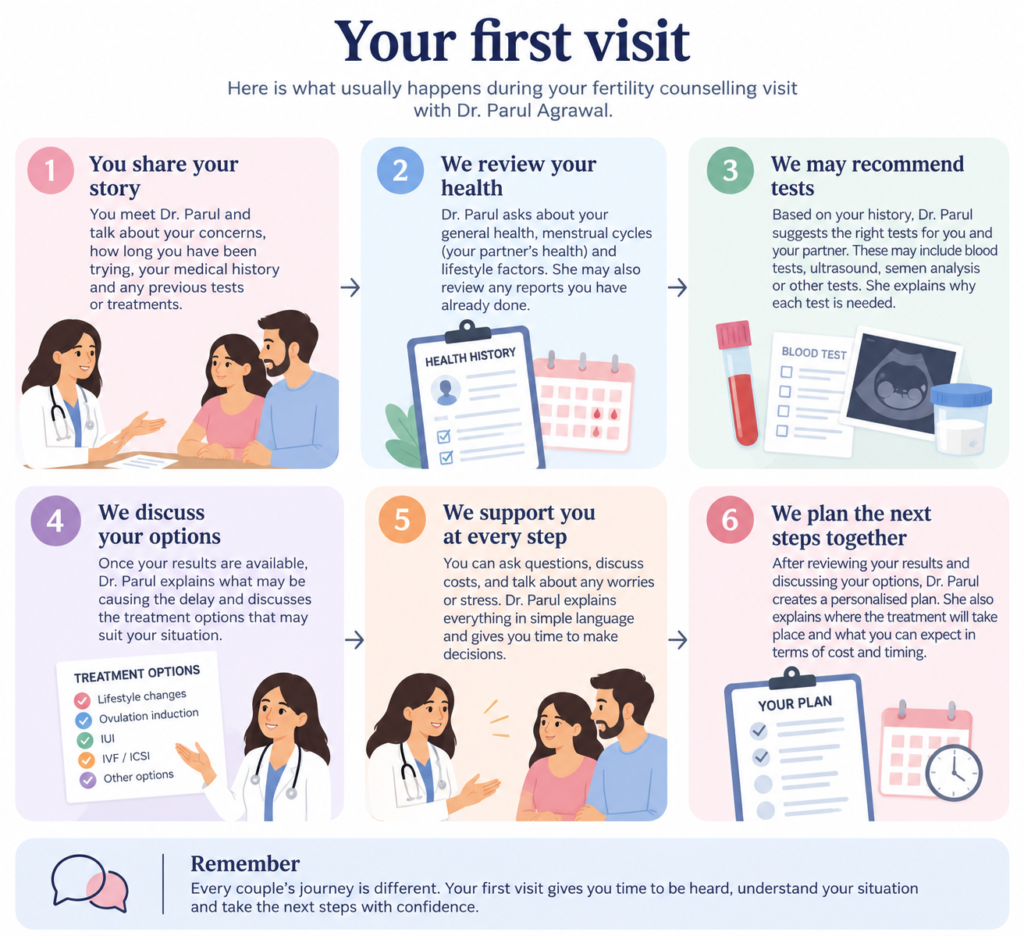
What happens in your first fertility consultation
Your first visit usually takes about 30–45 minutes. First, Dr. Parul listens to your concerns and asks about your periods, how long you have been trying to conceive, previous treatments, your health and your lifestyle. This helps her understand your situation and plan the right next steps.
- Dr. Parul listens to you first. She asks about your fertility history and encourages you to share your concerns openly. So, feel free to mention anything you think may be relevant.
- Both partners can attend. Since fertility can involve either partner, it is helpful to come together when possible. However, if your partner cannot attend the first consultation, you can still begin the evaluation on your own.
- Dr. Parul performs a basic check if needed. Depending on your situation, this may include a physical examination and an ultrasound scan.
- She recommends the necessary tests. Dr. Parul explains which tests you need, why you need them and when you should take them. Some tests may need to follow specific days of your menstrual cycle.
- You leave with a clear plan. Finally, Dr. Parul explains the next steps and answers your questions. Importantly, you do not have to start treatment on the same day.
What to bring: Bring your previous reports and scans, a list of your current medicines, your partner’s semen analysis if available, and any questions you want to discuss.
Tests your fertility doctor may recommend
Not everyone needs every test. After discussing your fertility history and concerns, Dr. Parul recommends only the tests that may help evaluate your situation. Common tests include:
| Test | What it checks | Who it is for |
|---|---|---|
| Pelvic ultrasound | The ultrasound checks the uterus and ovaries. It can show fibroids, cysts or polyps and can also count the small egg sacs (antral follicles) that help estimate your egg reserve. | Woman |
| AMH blood test | The AMH test measures a hormone that helps estimate the number of eggs remaining (ovarian reserve). In addition, you can take this test on any day of your cycle. | Woman |
| Hormone blood tests | These tests measure hormones such as FSH, LH, estradiol, thyroid (TSH) and prolactin. Some tests require specific cycle days. Additionally, a progesterone test can help show whether you ovulated. | Woman |
| Tube check (HSG or a similar test) | This test checks whether the fallopian tubes are open and whether the uterus has a normal shape. However, the doctor recommends it only when needed and performs it at a particular time in the cycle. | Woman |
| Semen analysis | The test checks sperm count, movement (motility) and shape (morphology). Usually, you should avoid ejaculation for 2 to 5 days before providing the sample. Because results can vary, the doctor may recommend a repeat test. | Man |
| Further tests | If an initial result appears abnormal, the doctor may recommend additional tests, including hormone tests, depending on your situation. | As needed |
These tests help Dr. Parul identify possible causes of fertility problems. However, a single test result does not determine your fertility outcome. Instead, Dr. Parul reviews each result in context and explains what it means in clear, simple language.
Emotional support: counselling for fertility problems
Trying to conceive can bring worry, guilt, sadness and relationship strain. In addition, some couples may feel pressure from family. These feelings are common, and they do not indicate weakness.
Dr. Parul gives you time to discuss how you feel during your first consultation and follow-up visits. She also explains your situation in clear, simple language so you can better understand what to expect. Meanwhile, you can take a few practical steps to manage the emotional pressure:
- Talk openly. Share your fears and concerns with each other instead of carrying them alone.
- Make decisions together. Discuss important treatment decisions as a couple and agree on how much you want to share with family.
- Take breaks when needed. Give yourself time to rest between appointments, tests and treatment steps.
- Ask for support. Reach out to people you trust when you need emotional or practical help.
If you feel very low, anxious or overwhelmed by the fertility journey, please tell Dr. Parul during your consultation. She can listen to your concerns and, when appropriate, suggest additional professional support.
What happens after your results?
Once Dr. Parul reviews your test results, she explains what may be causing the delay and discusses the treatment options that may suit your situation. Importantly, many couples do not need IVF. Instead, Dr. Parul may recommend one of the following options based on your fertility needs:
- Lifestyle changes and timed intercourse: These may help some couples who have a minor delay in conceiving.
- Ovulation induction: Dr. Parul may recommend this when you have irregular ovulation.
- IUI: This may help in cases such as mild male-factor infertility or unexplained infertility.
- IVF treatment or ICSI: Dr. Parul may recommend these treatments when other options are unlikely to work or have not worked.
- Male infertility treatment: She may recommend further evaluation or treatment when the semen analysis shows a problem.
- Laparoscopy or hysteroscopy: Dr. Parul may recommend these procedures when she suspects problems involving the fallopian tubes, uterus or endometriosis.
- Egg donation or egg freezing: She may discuss these options in specific situations.
Finally, Dr. Parul explains each step of your recommended plan, including where you will receive the treatment and what costs you can expect, so you can make an informed decision before proceeding.
Fee and how to book fertility counselling in Noida
- Consultation fee: Approximately ₹1,000. Consultation fees may vary, and any tests or additional procedures are charged separately.
- Appointments: Book your appointment by phone at 8826738888, Monday to Saturday, 9:30 am–6:30 pm.
- Address: A-127, Block A, Sector 92, Noida, Uttar Pradesh 201304. See directions and timings.
Why meet Dr. Parul Agrawal?
- You meet Dr. Parul personally. She listens to your concerns, understands your fertility history and guides you throughout your treatment journey.
- With 23+ years of experience, she brings extensive expertise in obstetrics, gynaecology and reproductive medicine and has been involved in 12,000+ IVF cases.
- She explains everything clearly. From your test results to your treatment options, she uses simple language and gives you the time you need to understand each step.
- She sets realistic expectations. While no doctor can guarantee a pregnancy, she discusses your individual situation, explains the factors that may affect your chances and helps you make an informed decision.
What patients say
“She listens with genuine empathy, never rushes, and makes you feel like you are her top priority.”
Priyanka Sinha
“She took the time to explain everything in a way that made sense, and I always felt supported by her both professionally and emotionally.”
Gaurav Chauhan
“Dr. Parul is professional, attentive, and took the time to listen to all concerns. She explained everything clearly and made sure we understood all her points.”
Toshi Singh
“She gives honest and clear answers about the doubts.”
Pratima
Frequently asked questions
1. Is fertility counselling the same as a fertility consultation?
In practice, you usually cover both during the same visit. First, you meet the doctor and discuss your fertility history. Then, Dr. Parul reviews your concerns, recommends any necessary tests and explains your treatment options. In addition, fertility counselling gives you an opportunity to discuss the stress and emotional concerns you may experience during your fertility journey.
2. Do I have to do IVF after counselling?
No. In fact, many couples can start with simpler treatment options. After reviewing your history and test results, Dr. Parul recommends IVF only when other options may not work or have not worked.
3. Do both partners need to come?
It is best for both partners to attend because fertility problems can affect either partner. However, if your partner cannot attend, you can still start the consultation on your own.
4. How many sessions will I need?
Often, one or two visits may be enough to review your results and create a treatment plan. However, the number of follow-up visits depends on your individual situation.
5. Which tests will I need?
The tests depend on your fertility history and concerns. For example, your doctor may recommend some of the tests listed in the table above. After reviewing your situation, Dr. Parul will explain which tests you need and why.
6. Is this the same as therapy?
No. Dr. Parul provides medical counselling and emotional support related to fertility. However, if you need therapy for anxiety, depression or other mental health concerns, the clinic can suggest a qualified mental health professional.
7. On which day of my cycle should I come?
You can attend your first consultation on any day of your menstrual cycle. However, some fertility tests require specific cycle days. Therefore, the clinic team will tell you when to schedule those tests.
8. How much does it cost?
The consultation fee is approximately ₹1,000. However, the final fee and what it includes should be confirmed with the clinic. Tests and additional procedures may be charged separately.
9. How soon will I get my reports?
The time depends on the type of test. Once your reports are ready, the clinic team will tell you when to return so Dr. Parul can review the results with you and explain the next steps. [CONFIRM TURNAROUND]
Book your first step for fertility counselling in Noida
Reviewed by Dr. Parul Agrawal, MBBS, DGO, DNB in Obstetrics & Gynecology, Fellowship in Reproductive Medicine (ICOG recognised), Reg. no. MCI 43617.
This page is for general information and does not replace medical advice. Last reviewed: [01-09-2026] by Dr. Parul Agrawal.